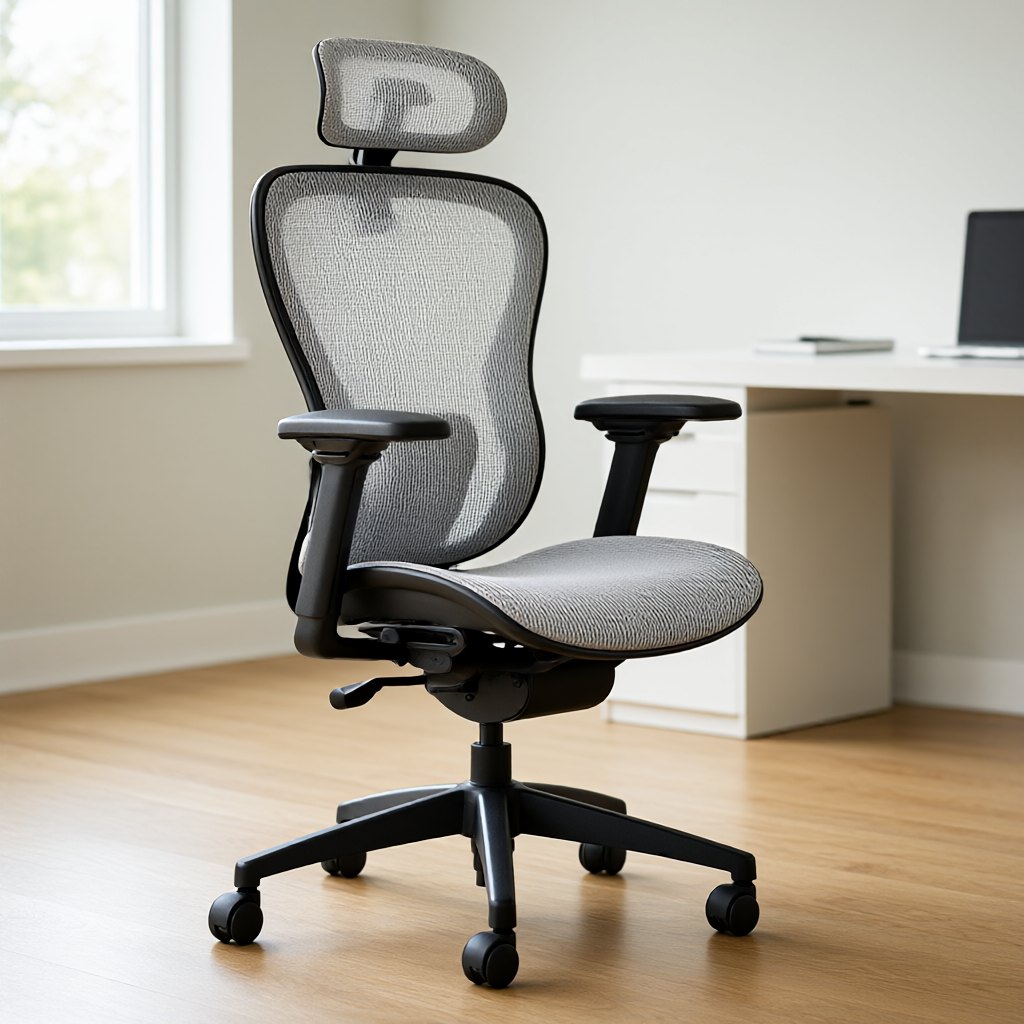
Choosing a plus size office chair depends on three measurable factors: weight rating, seat width, and adjustment travel. A chair rated for a 250 lb user will structurally fail under higher continuous load, and insufficient seat width or inadequate adjustment travel forces asymmetric sitting postures that concentrate pressure on the thighs and spine. Matching these three parameters to the user's body dimensions prevents equipment failure and reduces ergonomic strain.
Weight Rating Standards and Test Protocols
The ANSI/BIFMA X5.1 standard for general-purpose office chairs bases its mechanical tests on a 125 kg (275 lb) user reference weight. Prior to 2017, this test threshold was 115 kg (253 lb). The standard requires chairs to survive 100,000 seat impact cycles, 120,000 swivel cycles, and 300,000 backrest recline cycles, simulating roughly ten years of single-shift use. If a chair only claims to meet X5.1, its structural design ceiling aligns with that 275 lb threshold, leaving no margin for users weighing more.
For higher weight requirements, ANSI/BIFMA X5.11 defines the standard for large-occupant chairs. This standard bases all testing procedures on a 181 kg (400 lb) user. The structural tests apply higher force values across the same cycle counts. When evaluating a chair, the specification must state whether the weight rating is independently tested to the X5.11 protocol or merely a manufacturer claim. A tested 400 lb rating provides a verified structural limit, whereas an untested claim lacks the cycle-test validation that proves joint and base durability under sustained load.
Seat Width and Hip Breadth Clearance
Seat width dictates whether the user fits within the chair boundaries without lateral hip compression. ANSI/BIFMA X5.11 mandates a minimum seat width of 56 cm (22 inches) for large-occupant chairs. To determine the necessary seat width, measure the user at the widest point of the hips or thighs while seated. Add 5 cm (2 inches) to this measurement for clothing clearance and lateral shifting room. If the seated hip breadth measures 50 cm, the minimum seat width required is 55 cm, making the 56 cm X5.11 minimum barely adequate. Users with broader hips require seats exceeding 60 cm.
When armrests are present, the critical metric becomes hip breadth clearance at the narrowest point between the armrest pads or armrest supports. European standard EN 1335-1:2020 sets minimum hip breadth clearance with armrests at the widest point. For Type Ax and Type A chairs, this minimum clearance is 480 mm. For Type B and Type C chairs, the minimum clearance is 460 mm. If the distance between the inner edges of the armrests is narrower than the user's seated hip breadth, the armrests will compress the thighs or force the user to sit with arms elevated, leading to shoulder and upper back fatigue.
Seat Height Adjustment Travel
Seat height adjustment travel determines the range of popliteal heights the chair can accommodate. The gas cylinder must allow the seat pan to drop low enough for the user's feet to rest flat on the floor with knees at roughly 90 degrees, and rise high enough to reach the desk height. EN 1335-1:2020 classifies seat height ranges and minimum adjustment travel by chair type. Type Ax covers 400-540 mm with a minimum travel of 160 mm. Type A covers 400-520 mm with 130 mm travel. Type B covers 420-510 mm with 100 mm travel. Type C covers 430-480 mm with only 80 mm travel.
Plus size users often require greater adjustment travel because body mass affects seat pan depression under load. A pneumatic cylinder rated for a standard load will compress further under a heavier user, lowering the effective seat height by several centimeters. A chair with a specified range of 400-520 mm may sit 20-30 mm lower in practice for a user weighing over 300 lb. Selecting a chair with Type Ax adjustment travel (160 mm) provides the necessary margin to compensate for this load-based compression and still achieve a proper foot-flat posture.
Seat Depth Adjustment and Backrest Dimensions
Seat depth must leave a gap between the front edge of the seat pad and the back of the user's knees to avoid posterior knee compression. EN 1335-1:2020 requires a minimum seat pad depth of 380 mm and a minimum backrest height and width of 360 mm. For chairs with adjustable seat depth, Type Ax requires a range of 380-430 mm with a minimum travel of 70 mm, and Type A requires 425-450 mm. A fixed seat depth that is too long forces the user to sit forward away from the backrest, losing lumbar support. A seat depth that is too short concentrates pressure on a smaller area of the thighs, increasing tissue compression.
Backrest width and height minimums of 360 mm ensure the backrest covers the thoracic region, but plus size users often need broader backrests to laterally support the torso without causing the arms to abduct outward. If the backrest is too narrow, the user's shoulders roll forward internally. Measure the widest part of the seated torso and compare it to the backrest width to ensure the backrest pads or shell edges do not dig into the scapulae or ribcage.
Armrest Width and Padding Surface Area
Armrests on plus size chairs must support the forearms without forcing the elbows into a narrow, elevated position. The armrest pads should be wide enough to distribute the weight of the arms and long enough to support the forearms when reclining. Standard armrest pads often measure 50 mm in width, which creates a pressure point for larger forearms. Pads measuring 75-100 mm in width distribute this load over a larger surface area, reducing capillary compression in the forearms.
The distance between armrests must align with the user's seated elbow breadth. If the armrests are set too close together, the user must either rest only the elbows on the pads, straining the ulnar nerve, or squeeze the arms inward, activating the upper trapezius muscles. Adjustable armrests that pivot outward or slide laterally allow the user to set the exact width required by their shoulder structure and seated girth.
Verification Checklist for Plus Size Office Chairs
Confirm the chair is tested to ANSI/BIFMA X5.1 (275 lb) or X5.11 (400 lb) standards rather than relying on untested manufacturer claims. Measure seated hip breadth and add 5 cm to find the minimum seat width; verify the chair meets or exceeds this number. Measure the inner clearance between armrests or armrest supports to ensure it exceeds seated hip breadth by at least 20 mm.
Calculate the required seat height range based on popliteal height plus footwear, accounting for 20-30 mm of gas cylinder compression under higher body weight. Ensure the chair offers at least 130 mm of seat height adjustment travel (Type A or Type Ax under EN 1335-1:2020). Verify adjustable seat depth travel is at least 70 mm to accommodate varying femur lengths. Check that the backrest width exceeds the user's seated torso width to prevent scapular impingement.