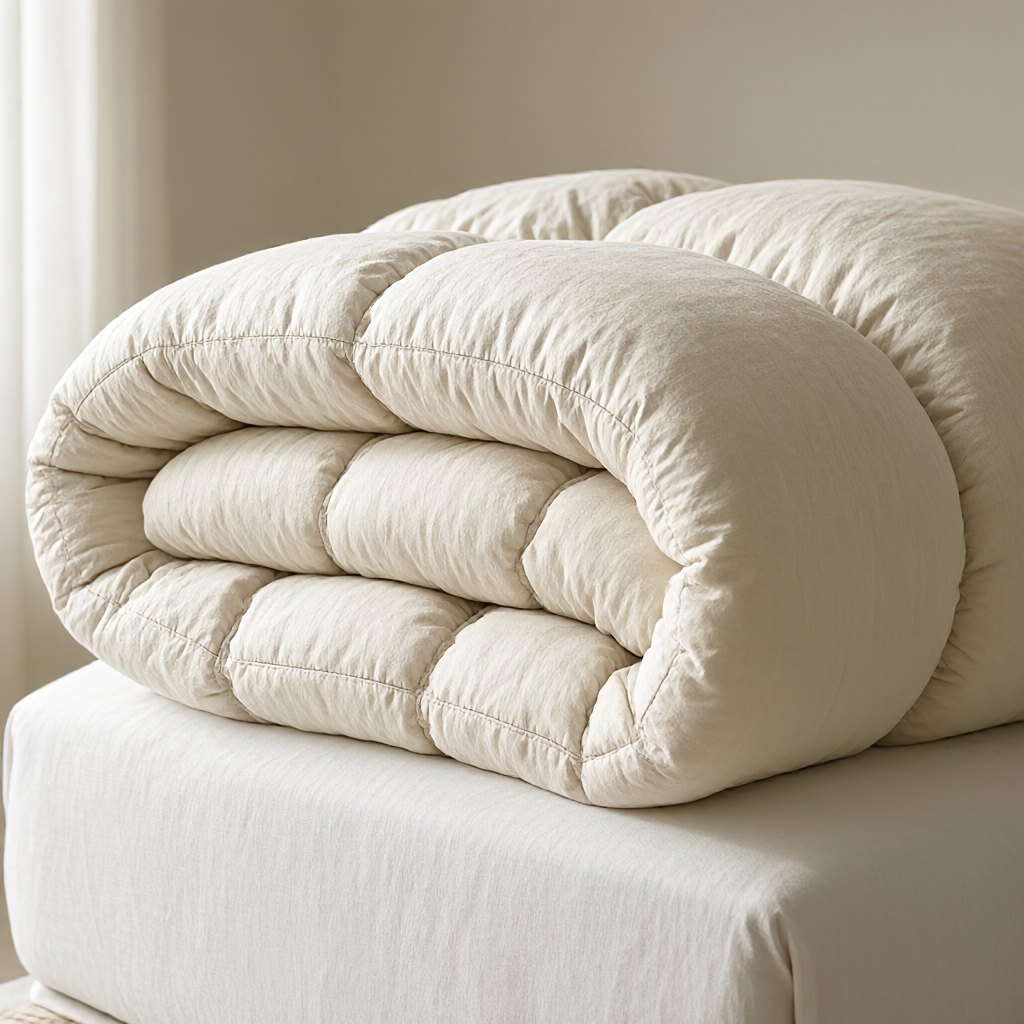
For plus size sleepers, winter bedding fails in two predictable ways: the duvet does not cover the shoulders and hips when turning, and the fitted sheet pops off the mattress corners. Both problems trace back to specific measurements that can be checked before purchase. This guide sets out the TOG band that matches your bedroom temperature, the fill type that holds warmth under body weight, the construction that prevents cold seams, and the fitted sheet depth that keeps the sheet in place all night.
TOG Bands for Winter Warmth
TOG measures thermal resistance. Winter duvets fall into two practical bands for most homes: 12.0 to 13.5 TOG for rooms at 17°C or below, and 15.0 TOG or higher for rooms that drop below 12°C or for sleepers who run cold. A 12.0 TOG duvet is the common winter weight for a standard bedroom. A 15.0 TOG duvet is the warmest standard grade and suits very cold rooms or sleepers who want maximum insulation without adding blankets.
Do not assume a higher TOG is always better. A 15.0 TOG duvet in a bedroom kept at 18°C will trap too much heat for a heavier sleeper, causing night sweats and dampness against the skin. The correct approach is to match the TOG to the lowest expected room temperature. If the bedroom sits at 17°C or above, a 12.0 TOG duvet is sufficient. If the room drops below 15°C, move to 15.0 TOG. For sleepers who generate more body heat, a 10.5 TOG duvet can work in winter as long as the room stays above 16°C.
Consider layering instead of buying an extreme duvet. A 12.0 TOG duvet plus a 4.5 TOG blanket or a 3.0 TOG summer duvet on top creates adjustable warmth. This approach is useful for plus size sleepers who overheat during part of the night and then cool down toward morning.
Fill Type: Down vs Synthetic
Down fill provides a higher warmth-to-weight ratio than synthetic fill of the same rating. A 12.0 TOG down duvet is lighter than a synthetic duvet at the same TOG, which matters for plus size sleepers who feel trapped under heavy bedding. Lightweight bedding reduces pressure on the body and makes turning easier. Down also breathes, allowing moisture to escape, which helps prevent the clammy feeling that can occur with synthetic fills.
Synthetic fill has advantages for certain users. It is hypoallergenic, easier to wash, and less expensive. For a plus size sleeper who sweats heavily at night, a synthetic duvet with a high GSM weight can be a practical choice, but the weight will be greater. A 12.0 TOG synthetic duvet may weigh 30 to 40 percent more than a down duvet at the same TOG, and that extra weight translates into more resistance when turning in bed.
For winter use, choose a fill with good loft recovery. Down with a fill power of 600 or higher will bounce back after compression, which matters when a heavier body compresses the duvet through the night. Lower fill power down or dense synthetic fills flatten under weight and lose their insulating air pockets. A duvet that stays flat will not trap warmth effectively.
Baffle Box vs Sewn-Through Construction
Baffle box construction creates vertical fabric walls between the fill chambers, allowing the fill to loft fully within each box. This prevents the fill from shifting and avoids cold spots at the seams. For a plus size sleeper, baffle box construction is the better choice because the duvet maintains its thickness under the weight of a larger body. The fill stays evenly distributed, so the duvet continues to insulate across the entire sleeping area.
Sewn-through construction stitches the top and bottom layers together directly at the seams, which compresses the fill at each stitch line. These compressed lines become cold spots, and they become more visible after three to five years of use. A heavier sleeper puts more pressure on the sewn-through seams, accelerating the compression and creating noticeable cold bands across the duvet. Over time, the duvet loses warmth at the exact points where the body needs it most.
Check the baffle height before purchase. A baffle height of 3 to 5 cm is typical for winter duvets. Taller baffles allow more fill and greater loft, but they also add weight. For a plus size sleeper, a baffle height of 4 cm or more is a good balance between insulation and ease of movement.
Duvet Size and Overhang
The duvet must cover the full mattress width plus overhang on both sides. A standard double duvet measures 200x200 cm, a king measures 230x220 cm, and a super king measures 260x220 cm. For a double bed, a king duvet is the safer choice for a plus size sleeper because the extra width keeps the duvet over the shoulders and hips when turning. The duvet should extend a few centimetres beyond the mattress edge on each side, and the length should cover the mattress plus the pillow area.
An insert that is too small sits flat and does not loft. The cover should be 2 to 4 inches larger than the insert in each direction, allowing the fill to expand. If the insert exactly fills the cover, the duvet will look flat and will not trap air. For a plus size sleeper, a flat duvet provides less insulation and feels colder.
When in doubt, choose the wider size. A duvet that covers the whole mattress width plus a few centimetres of overhang will still cover the sleeper through the night. A duvet that is too narrow will pull off the shoulder on one side when the sleeper turns, exposing the back to cold air.
Fitted Sheet Depth and Turn Resistance
Fitted sheet pocket depth must match the mattress thickness including any topper. Standard fitted sheets fit mattresses up to 25 to 30 cm deep. Deep-fitted sheets stretch to 30 to 40 cm. Extra-deep sheets cover 40 to 46 cm. For a plus size sleeper with a thicker mattress or a mattress topper, an extra-deep sheet is usually the correct choice. Measure the mattress at its thickest point, including any topper, before buying.
A pocket that is too shallow will pop off the corners overnight. This happens more often for plus size sleepers because the additional body weight and movement during the night put more stress on the sheet corners. A sheet with a 40 to 46 cm pocket depth holds securely on a mattress that measures up to 40 cm thick, and the elastic band should be continuous around the entire perimeter.
Turn resistance also depends on the sheet's elastic quality and the fabric weave. A jersey knit sheet with high elastic recovery will stay in place better than a percale sheet with lower stretch. Check that the elastic is wide and sewn into a hem that does not roll. A sheet with a narrow elastic band can twist and lose tension, causing the corners to lift during the night.
Checklist for Winter Bedding Selection
Measure the bedroom temperature at the lowest point of the night and select a TOG band accordingly. Use 12.0 to 13.5 TOG for rooms at 17°C or below, and 15.0 TOG for rooms below 12°C. Choose down fill for lighter weight and better breathability, or synthetic fill if hypoallergenic properties matter more than weight. Select baffle box construction with a baffle height of at least 4 cm to maintain loft under body weight. Pick a duvet size that covers the full mattress width plus a few centimetres of overhang on each side. Measure the mattress at its thickest point including any topper, and choose a fitted sheet with a pocket depth that exceeds that measurement by at least 2 cm. Check that the fitted sheet has a continuous elastic band and a wide hem that does not roll. Test the sheet by pulling the corners after making the bed; the corners should not lift when you tug on the side. Layering a lighter duvet or blanket over a winter duvet provides adjustable warmth for sleepers who overheat during the night.