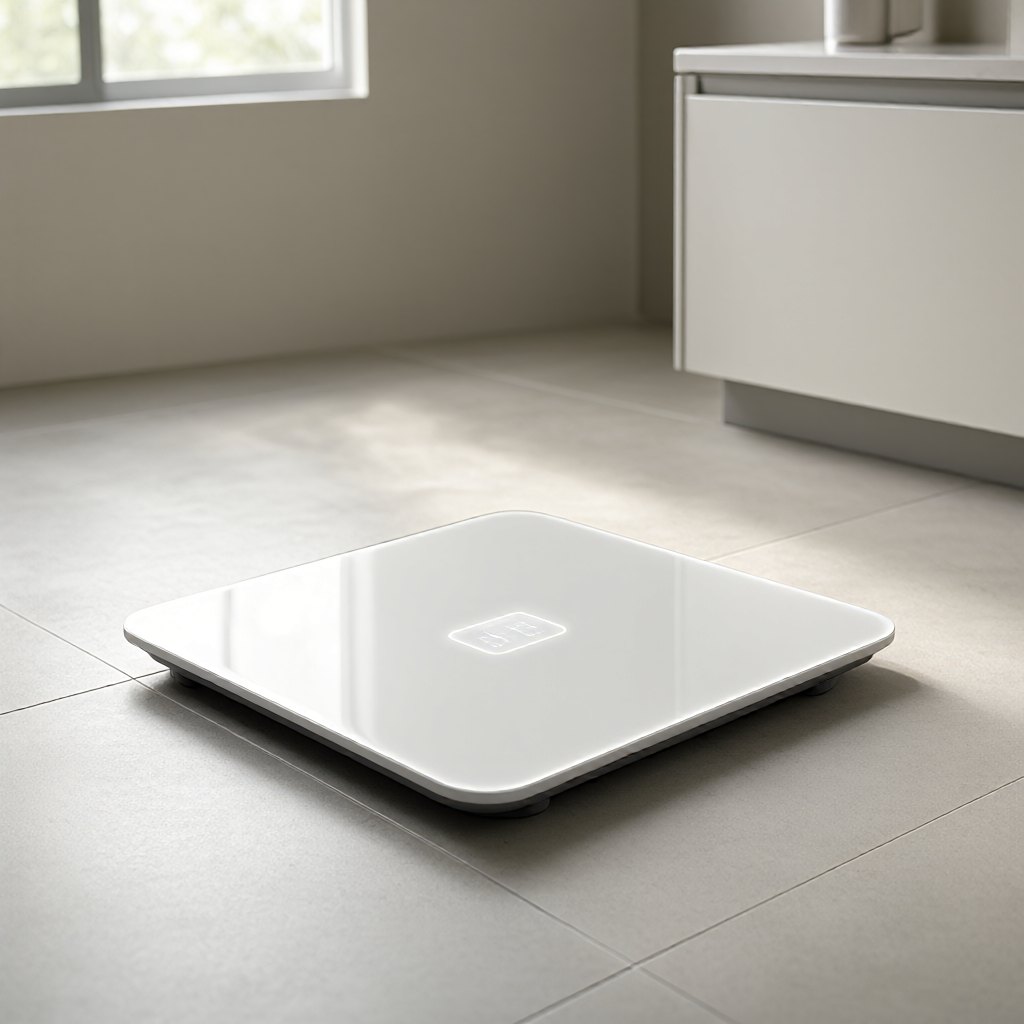
Selecting a bathroom scale for a plus size user requires checking more than the weight limit. The platform must accommodate foot width, sensors must handle the load without drift, and the display must be readable without bending. This guide covers specific criteria for platform size, capacity, increment resolution, and readability to ensure consistent measurements.
Platform Size and Foot Placement
A narrow platform forces feet over the edges, shifting weight off-center and causing inconsistent readings. For plus size users, a platform width of at least 32 cm (12.6 inches) is a practical minimum, while 35 cm or wider offers a more stable stance. A depth of 30 cm or more allows heels to rest comfortably. A square or rectangular platform with a diagonal exceeding the user's shoe length by at least 5 cm reduces slip risk. The surface should be textured or have a raised edge to prevent sliding. For users with a wide stance or using a cane/walker, a low-profile platform (5 cm or less) allows stepping on safely. A non-slip base and low center of gravity further reduce wobble.
Maximum Capacity and Sensor Margin
Accuracy may degrade near the stated maximum capacity. Look for a capacity exceeding your expected weight by at least 20% to ensure load cells operate within their linear range. For example, at 150 kg, a 200 kg capacity provides an adequate 50 kg margin; at 180 kg, the 20 kg margin may lead to calibration drift. High-capacity scales often use four independent sensors; strain-gauge sensors are preferable to less accurate spring-based ones. A 200 kg capacity with 0.1 kg readability is preferable to 0.2 kg increments for tracking small changes. A built-in overload indicator warns when the load exceeds capacity, preventing sensor damage and false readings.
Increment Resolution and Readability
Increment resolution is the smallest weight change displayed. A 0.1 kg (0.2 lb) increment is standard, but 0.05 kg (0.1 lb) is useful for monitoring small changes like fluid retention, though finer increments require a stable platform to avoid fluctuating numbers. Readability also depends on display size; a character height of at least 29 mm (1.1 inches) is recommended, along with backlight or high contrast for dim lighting. A tilted or raised display avoids leaning forward. A hold or average function locks the reading after stability, useful for those who cannot stand perfectly still; it should wait until weight variation is below a threshold before locking.
Stability and Floor Interaction
The scale must sit flat. Adjustable feet and a built-in spirit level prevent uneven load distribution, which can cause errors of 0.2 kg or more. A rigid steel or reinforced platform prevents flexing under heavy loads. Rubber feet or a textured base provide better grip than hard plastic on smooth tile. On carpet, a larger foot pad, rigid base, or hard board underneath prevents weight underestimation. Temperature and floor changes can affect the zero point; automatic zero-point adjustment compensates for variations, preventing drift up to 0.5 kg from temperature swings.
Verification and Calibration Checks
For clinical use, a class III verifiable scale with a calibration certificate is preferable. A verifiable 200 kg scale with 0.1 kg readability has a maximum permissible error of ±0.1 kg up to 100 kg, and ±0.2 kg up to 200 kg, tighter than consumer scales (up to 0.5 kg error). At home, check accuracy by weighing a known object (e.g., 10 kg dumbbell) three times; if readings vary by over 0.1 kg, there may be a sensor issue. Replace the scale if a consistent error exceeds 0.5 kg. For reproducibility, step on and off three times; readings should be within 0.1 kg. Drift over 0.3 kg indicates unreliability. A step-on activation that zeroes itself before weighing is preferable to one that reads immediately with transient error.
Practical Checklist for Selection
Before purchasing, verify: platform width ≥ 32 cm, depth ≥ 30 cm; capacity exceeding expected weight by ≥ 20%; increment ≤ 0.1 kg; display character height ≥ 29 mm; non-slip surface; low profile (≤ 5 cm); stable base with rubber feet. For balance issues, choose a hold/average function. For medical accuracy, look for a verifiable class III scale with calibration certificate. Test at home with a known weight and check reproducibility over three consecutive weighings to ensure reliable data without inconsistent numbers.