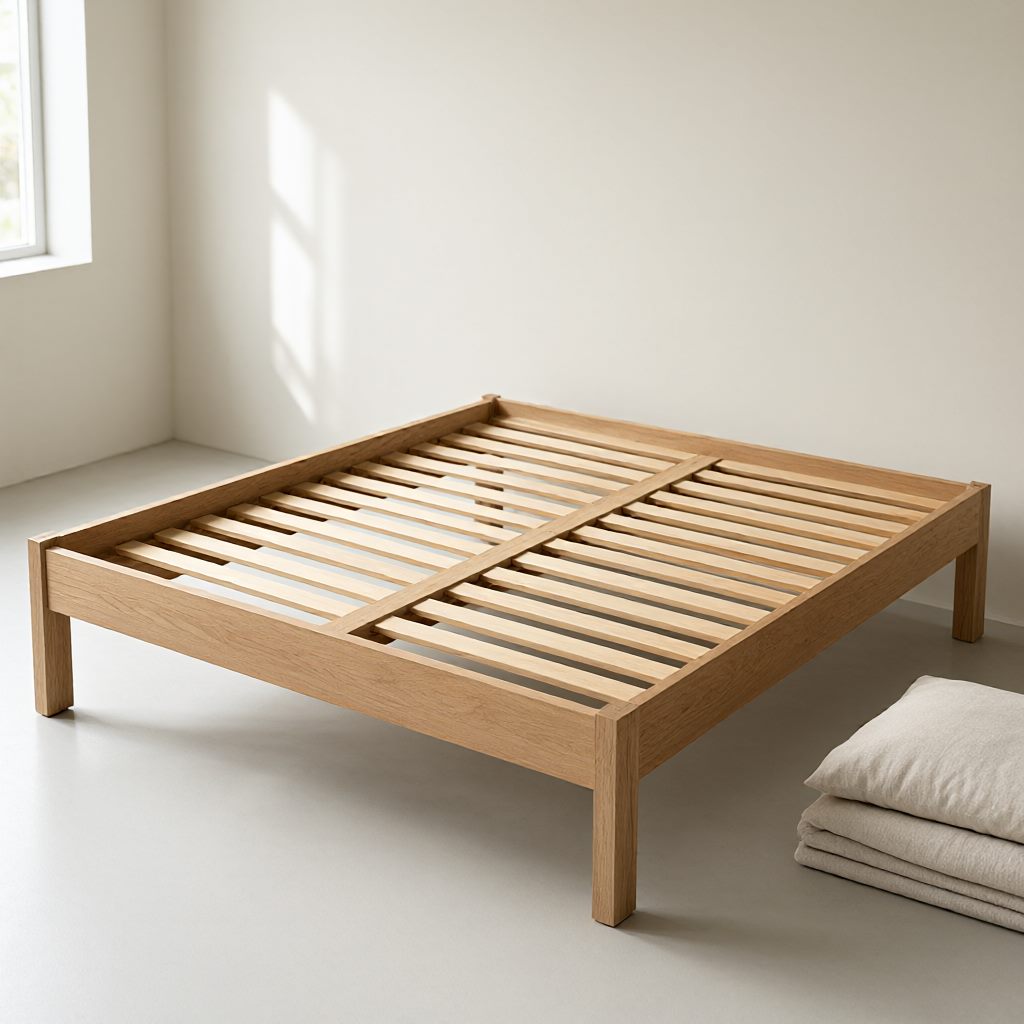
For a plus size sleeper, the bed frame is not a decorative accessory; it is a load-bearing structure that must support the combined weight of the mattress and the person without excessive deflection, squeaking, or permanent bending. The most common failure points are undersized slats spaced too far apart, a missing center rail on queen or king sizes, and support legs that do not reach the floor. The following specifications give concrete thresholds for evaluating any platform bed, slat base, or box spring alternative before purchase.
Slat Spacing and Width Limits
Slat spacing is the single most important dimension for preventing mattress sag. The maximum allowable gap between slats is 3 inches (7.6 cm). Wider spacing allows the mattress underside to dip between supports, which creates a wavy sleep surface and accelerates foam or spring fatigue. Closer spacing is always acceptable; there is no minimum gap requirement for structural reasons, though leaving a small gap for ventilation keeps the mattress underside dry.
Slat width must be within 0.5 inch of the gap size. If the gap is 3 inches, each slat should be at least 2.5 inches wide. This ratio ensures that the slat itself has enough bearing surface to distribute the mattress load without local indentation. In practical terms, a slat that is 2.5 to 3 inches wide paired with a 3 inch gap is a common and sound configuration. Narrower slats, below 4 cm (1.6 inches) in width, lose torsional stiffness and can twist under asymmetric load when a person sits on the edge of the bed.
For plus size users, slat thickness matters as much as width. A reinforced slat base should use slats at least 2.0 cm (0.79 inch) thick. Standard slat stock is 1.8 to 2.5 cm thick, and 7 to 10 cm wide for platform bed construction; the thicker end of that range is preferable for heavy loads. Slats thinner than 1.8 cm will flex noticeably under a concentrated load, especially when the sleeper gets in or out of bed, which produces a dynamic impact of 2 to 3 times the static body weight.
Center Rail and Support Leg Requirements
Queen and king size frames require a substantial center support structure. A single center rail running the length of the bed, supported by legs that reach the floor, is the minimum acceptable design. Without this center rail, the frame itself can bow under the combined weight of mattress and sleeper, even if the slats are correctly spaced. The center rail carries the midpoint load of each slat, and its presence reduces the unsupported span of the slat by half.
Support legs on the center rail should be spaced every 60 to 80 cm (24 to 31 inches) on double and larger beds. Very large sizes, such as California king or custom widths, may need two parallel center rails. Each leg must terminate on the floor with a flat foot pad; legs that hang in the air or rest on a thin crossbar provide no meaningful support. Legs should be substantial enough to resist buckling rather than thin dowels, and the connection between leg and rail should be a metal bracket or a screwed joint with wood glue, not a nail.
The center rail itself should be a solid beam or a metal channel with enough depth to resist visible deflection. A common failure mode is a center rail that is too shallow, which sags under the sleeper's weight even when the legs are present. Check the rail for straightness after assembly; a visible permanent deformation beyond 5 mm from original straightness is a maintenance signal and indicates that the frame is under-specified for the actual load.
Load Rating Interpretation for Heavy Sleepers
Published load capacity figures are useful only if interpreted correctly. A rating of 660 to 800 lb (300 to 360 kg) is common for retail platform frames with 12 to 13 slats. However, industry test methods apply a uniformly distributed load of 100 to 120 kg held for 24 hours and then measure residual deformation. This static test does not capture the dynamic forces of sitting up, turning over, or getting out of bed, which can produce peak impacts of 2 to 3 times the static weight.
For a plus size user weighing 110 kg (242 lb), the peak dynamic load on a single slat or on the center rail can exceed 300 kg momentarily. A frame rated for 800 lb may be adequate if the rating is based on a safety margin of at least 3 times the expected static load. A more reliable approach is to select a frame whose stated capacity covers several times the user's body weight, or to choose a reinforced slat base specifically designed for users over 90 kg. Reinforced bases typically use slats of 2.0 cm thickness, spacing no more than 3.5 cm, and extra slats in the lumbar zone to handle the highest-pressure region.
The 2000 N static load requirement from EN 1725, applied at the center of the sleep surface, is equivalent to about 204 kg of force. This is a minimum safety requirement for domestic beds, not a recommendation for plus size use. A heavy-duty frame should comfortably exceed this value, with a horizontal stability test of 100 N at the maximum side rail height producing no more than a few millimeters of lateral movement. Frame squareness tolerance is plus or minus 2 mm per meter of diagonal, and joint gaps should not exceed 1.5 mm.
Construction Details That Affect Durability
Slats should be attached to ledger strips or to the side rails with screws plus wood glue at intervals of 20 to 30 cm. Nails alone will work loose under repeated dynamic load, especially at the ends of the slat where the bending moment is highest. Screws should be long enough to penetrate the ledger strip fully rather than just biting the surface, and each slat should have at least two fasteners per end.
Bed surface height including the mattress typically lands at 45 to 55 cm. A lower frame is easier to get into and out of for plus size users, but the frame must still allow sufficient clearance for the support legs. Slat gaps serve a ventilation function; the mattress underside needs to breathe, so sealing the underside with plastic sheeting or a solid deck without gaps can trap moisture and lead to mold or foam degradation. A solid deck is not required for structural purposes, and the gaps are beneficial.
For pocket-spring mattresses, slat spacing around 5 cm (2 inches) is often specified by mattress manufacturers. This is tighter than the 3 inch maximum and provides extra support for individual spring pockets. If the mattress warranty specifies a maximum slat spacing, follow that specification rather than the general 3 inch rule, because a warranty claim can be denied if the frame does not meet the mattress maker's requirement.
Pre-Purchase Verification Checklist
Measure the slat gap with a ruler; it must be no more than 3 inches (7.6 cm) for queen and king, and no more than 2 inches (5 cm) for pocket-spring mattresses. Confirm slat width is within 0.5 inch of the gap. Check slat thickness is at least 2.0 cm for users over 90 kg. Verify the presence of a center rail on queen and king frames, with legs reaching the floor every 60 to 80 cm. Confirm the frame's stated load capacity leaves a wide margin over the user's body weight. Inspect the center rail height; it should be at least 5 cm deep. Look for screwed and glued joints, not nails. Ensure the underside is ventilated, not sealed with plastic. Measure bed surface height including mattress; 45 to 55 cm is typical. Check for any visible bowing or permanent deformation of slats or rails before final assembly.