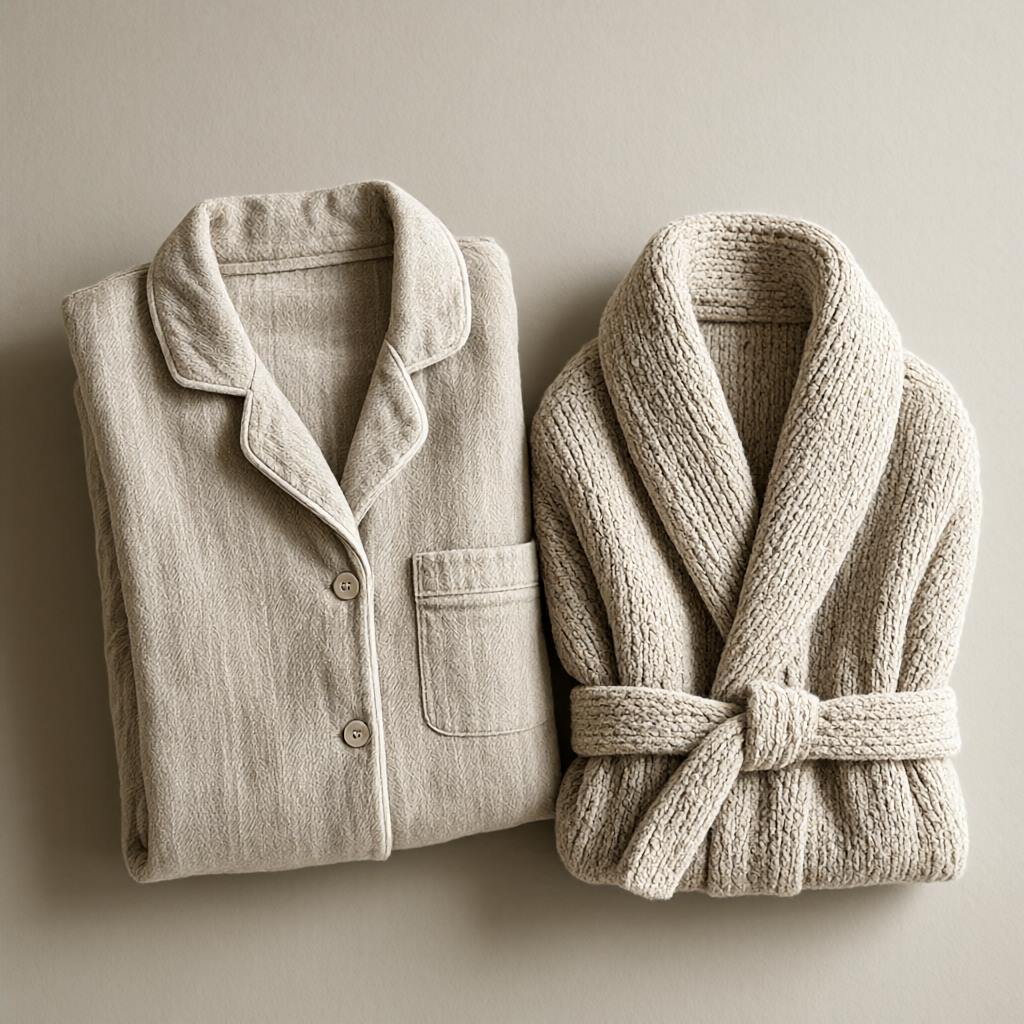
Plus-size winter sleepwear is usually chosen on warmth and on how the cloth feels against the skin, while the two properties that decide whether a garment can be sold as apparel are fabric weight and surface finish. Adult pajamas, robes and loungewear fall under 16 CFR Part 1610, which applies a 45-degree flame to a specimen and records how long the flame takes to travel a set distance. Those two properties determine whether a garment is exempt from testing, exempt by fiber content, or has to be tested and rated before it reaches a shelf.
Fabric Weight in GSM and Ounces
Fabric weight is quoted in grams per square meter, and a US label may quote ounces per square yard instead. The two figures describe the same cloth but are not interchangeable at a glance, and the conversion matters here because 2.6 oz per square yard, about 88 grams per square meter, is the threshold written into the flammability rule rather than a warmth rating. A heavier cloth usually traps more air and feels warmer, yet weave, fiber and surface finish change the result: a brushed flannel and a smooth poplin of the same weight behave differently beside a flame and differently in bed.
The practical reading is that weight is a filter rather than a verdict. Three entries from the label do most of the work: the weight in grams per square meter or ounces per square yard, the fiber content, and whether the surface is plain or raised. Those entries point to the route described in the next section, and they matter more than a few grams of difference between two otherwise similar fabrics.
Surface Finish Decides the Flammability Route
Plain-surface fabrics and raised-surface fabrics are treated separately under 16 CFR 1610. Plain surfaces include smooth jersey knits and woven poplin; raised surfaces include brushed cotton flannel, coral fleece and polar fleece, where fiber is lifted from the base cloth. A plain surface rates Class 1 at a flame spread time of 3.5 seconds or more. A raised surface needs more than 7.0 seconds for Class 1, and a raised fabric that burns between 4.0 and 7.0 seconds while setting the base cloth alight is Class 2, which is permitted for raised apparel. Anything faster, meaning a plain surface under 3.5 seconds or a raised surface under 4.0 seconds with the base cloth burning, is Class 3 and cannot be used in clothing.
Two exemptions carry most of the practical weight. A plain-surface fabric of any fiber at 2.6 ounces per square yard or heavier is exempt from testing, and a fabric made wholly of acrylic, modacrylic, nylon, olefin, polyester or wool is exempt at any weight and in any finish. Brushed cotton flannel sits outside both: brushing makes it a raised surface, and cotton is not on the fiber list, so the cloth has to be tested. For a plus-size winter wardrobe built on flannel, that is the one fabric in the drawer that needs documentation rather than an assumption.
Cuff and Ankle Construction
Cuffs and ankle openings control the air inside the garment. A loose opening lets warm air leave and cold air enter, which defeats the insulation of the cloth; an opening held by a narrow elastic band leaves a mark on the wrist or calf and restricts circulation through the night. The useful middle ground is a ribbed knit with enough recovery to close against the limb without indenting the skin, in a 1x1 or 2x2 rib rather than a flat band.
Rib structures are graded by the number of stitches, so a cuff cut from the same rib as the body has limited stretch. On a plus-size pattern the cuff is usually cut wider and shorter to compensate, and the elastic inside the hem is set looser than on a straight-size garment. Two checks settle the question in a fitting room: the cuff should sit flat after being stretched over the hand and released, and it should leave no deep groove after a minute on the wrist. An ankle opening that closes with a drawstring gives more range than a fixed elastic hem, at the cost of a cord that has to be managed.
Seam Placement and Layering Room
Seams are the part of sleepwear that decides comfort after the first hour. Flatlock seams lie flat against the skin and suit knits worn directly on the body; overlock seams are standard on wovens but leave a ridge that can irritate. On a plus-size pattern the side seam carries more tension across the hip and waist, so a three-thread overlock is a weaker choice there than a four-thread or five-thread safety stitch, which adds a second row of stitching to stop the seam from opening under load.
Layering changes the cut requirement. A robe worn over a pajama set needs enough room at the shoulder and armhole that the sleeve of the inner layer does not bunch, and a raglan sleeve moves the underarm seam away from the armpit, which reduces friction when a second layer sits on top. The useful test is a reach: both arms raised above the head, then forward. If the shoulder seam pulls or the armhole cuts into the arm, the outer layer is too narrow regardless of its stated size.
Checks Before Purchase
Fabric weight: recorded from the label in grams per square meter or ounces per square yard, and compared with the 2.6 ounce threshold rather than with a warmth claim.
Fiber content: listed on the care label, and checked against the six fibers that carry a testing exemption.
Surface finish: identified as plain or raised by looking at the cloth against the light and running a hand against the nap.
Flammability documentation: requested for brushed cotton flannel and any raised surface that is not a listed synthetic or wool.
Cuff recovery: the cuff returns to its original size after stretching over the hand, and leaves no deep mark on the wrist.
Seam type: flatlock on knits worn against the skin, four-thread or five-thread safety stitch at the side seam of wovens.
Layering room: arms raised and reaching forward with both layers on, with no pull at the shoulder seam or armhole.
Care and Fit After Washing
Sleepwear is washed often, and the first wash changes the fit more than the size chart suggests. Cotton flannel shrinks along the warp and can lose length at the sleeve and ankle, which turns a comfortable cuff into a tight one; polyester fleece holds its dimensions but pills where the surface rubs. Washing at the temperature on the care label and drying on low keeps the shrinkage predictable, and measuring the sleeve and inseam before and after the first wash gives a real number for the next purchase.
The flammability class does not change with washing for an untreated fabric, but surface finishes do: brushing flattens over time, and a raised surface that has been worn smooth behaves more like a plain one. That is a comfort change rather than a compliance change, and it is one more reason to record the fiber and test status at purchase rather than relying on how the garment feels in the third season.