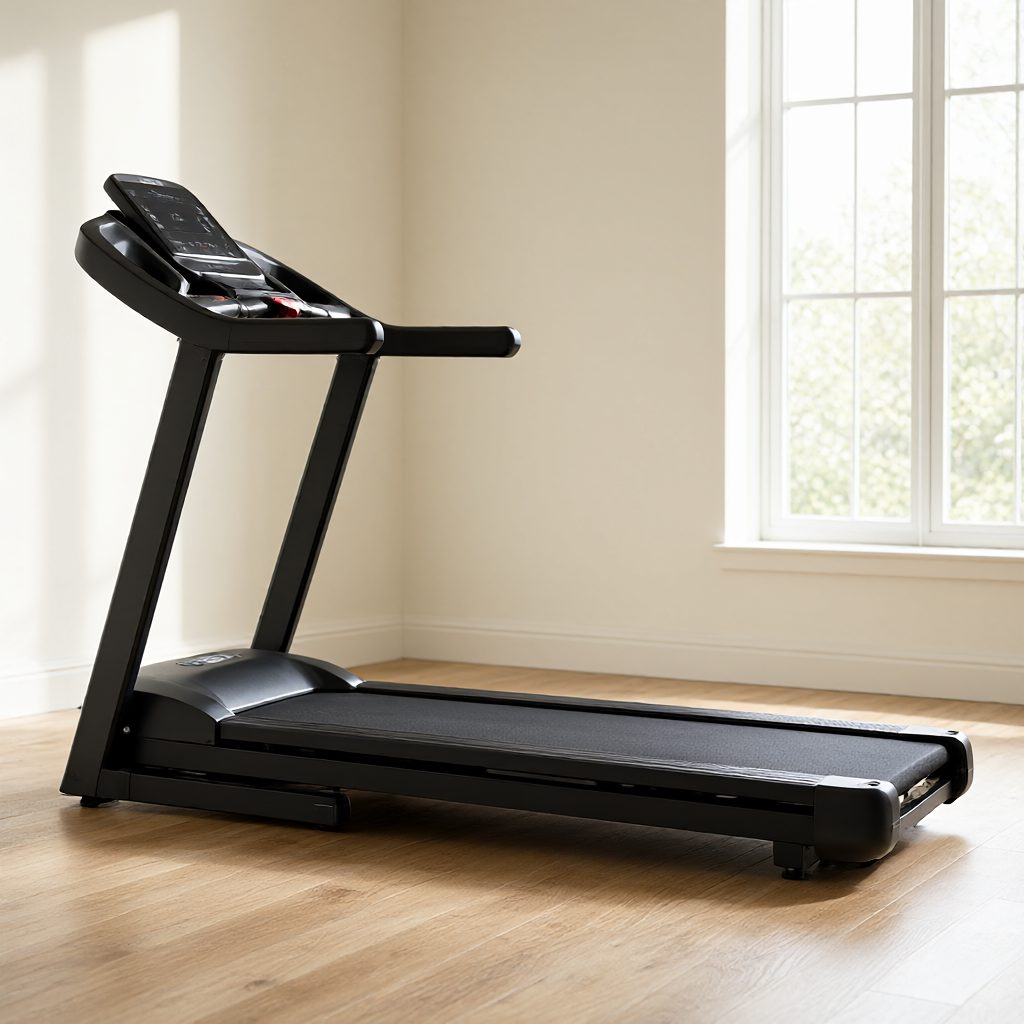
Selecting a home treadmill for a plus-size user involves filtering marketing specifications against structural and mechanical limits. The four failure points for heavier users are motor burnout under sustained load, frame flex at maximum weight, belt edge friction from a narrow stride, and joint pain from inadequate deck cushioning. Evaluating continuous horsepower, weight margin, belt dimensions, and deck construction provides the necessary data to avoid these issues.
Max User Weight and Structural Margin
Treadmill weight capacities represent the upper structural limit, not a comfortable operating range. A machine rated for 300 pounds will stress frame welds, rollers, and the deck when a 300-pound user runs on it, because running impact forces exceed static body weight. ISO 20957-6:2021 and EN 957-6 test protocols apply sustained loads to verify frame integrity and motor thermal limits under stress, but real-world running adds dynamic force.
Calculate the required weight capacity by taking the heaviest user’s weight and adding a 20 percent margin, or a 50-pound buffer, whichever is higher. For a 250-pound user, the 20 percent margin dictates a minimum machine rating of 300 pounds, while the 50-pound buffer dictates 300 pounds. For a 350-pound user, the 20 percent margin requires a 420-pound capacity, making a heavy-duty treadmill rated for 400 pounds or more the baseline. Consumer treadmills typically cap at 250 to 350 pounds; units supporting 400 pounds and above feature thicker deck materials and wider frame tubing.
Verify the sustained-load testing compliance. A properly rated 3 HP continuous motor running at 14 km/h with a 100 kg load for 60 minutes must maintain a casing temperature under 80 degrees Celsius. Suppliers unable to state a continuous rating rarely hold load and endurance test documentation, indicating the stated weight capacity may rely on static rather than dynamic testing.
Belt Width and Length Requirements
Belt dimensions dictate stride accommodation and lateral foot clearance. Standard walking belts measure 48 by 16 inches, which restricts a plus-size user’s natural gait. Wider stances and lateral foot drift during fatigue require more surface area to prevent foot strikes against the motor hood or side rails.
For walking, set a minimum belt size of 48 by 16 inches. For light jogging, increase the requirement to 52 by 18 inches. For running, the baseline shifts to 54 by 20 inches. Plus-size users often benefit from a 20-inch belt width regardless of speed to accommodate a wider stance. Taller users exceeding six feet must extend the length requirement to 58 or 60 inches to prevent toe-off drag at the front roller. Metric equivalents for running belts start at 130 by 42 cm.
Check roller diameter alongside belt dimensions. Mid-range machines use 38 to 45 mm rollers. Larger rollers decrease belt flex stress, reduce heat buildup, and extend belt life under heavy loads. A roller diameter below 38 mm correlates with faster belt wear and higher maintenance frequency for users over 200 pounds.
Continuous Horsepower vs Peak Horsepower
Motor ratings divide into continuous duty horsepower (CHP) and peak horsepower (PHP). CHP measures the power a motor sustains indefinitely under real load without overheating. PHP represents the maximum power a motor reaches momentarily before thermal shutdown, and typical peak-to-continuous ratios run roughly 3:1 in this motor class. A treadmill advertising 6.0 peak HP often delivers only 2.0 CHP.
Rely exclusively on the CHP rating. For users under 200 pounds walking, 2.0 CHP suffices. For users under 200 pounds walking or light jogging, select 2.5 CHP. For users over 200 pounds, or any user running regularly, the minimum requirement is 3.0 CHP. Daily heavy use by users over 200 pounds necessitates 3.0 to 3.5 CHP. Commercial treadmills rated under EN 957-6 Class S typically feature 3.0 to 5.0 HP continuous motors to handle these loads.
Motor controller quality affects CHP delivery. A treadmill holding ISO 20957-6:2021 Class H (home) or Class S (commercial) certification confirms that the motor holds stated CHP within a 5 percent speed deviation under load. Uncertified motors often suffer speed fluctuations when a heavy user strikes the belt, indicating the controller cannot maintain current draw under impact.
Deck Cushioning and Thickness Standards
Deck construction determines shock absorption and structural stability. A thin deck flexes under heavy loads, causing belt tracking issues and motor strain. Deck thickness on treadmills suitable for plus-size users ranges from 18 to 25 mm. Decks below 18 mm risk cracking or permanent bowing when subjected to running impacts from users over 200 pounds.
Cushioning systems vary from simple rubber buffers to multi-point elastomer configurations. An 8-point elastomer cushion system distributes impact forces across the deck length, varying firmness at the front impact zone and rear push-off zone. This design reduces joint stress while maintaining a stable surface at mid-deck. Avoid treadmills relying solely on thin foam pads under the belt, as these compress permanently under heavy loads and lose shock absorption within months.
Evaluate deck suspension adjustability. Some heavy-duty treadmills offer variable cushioning settings. A firmer setting suits walking, where excessive cushioning creates an unstable surface that strains ankles. A softer setting benefits running, where impact forces multiply. The ability to lock out cushioning entirely mimics road surface conditions for users training for outdoor events.
Pre-Purchase Verification Checklist
Apply the following checks before purchasing a home treadmill for a plus-size user. These steps bypass marketing language to verify structural and mechanical adequacy.
Weight capacity check: Multiply the heaviest user's weight by 1.2. If the result exceeds the treadmill's rated capacity, reject the unit. Add a 50-pound buffer as an alternative minimum requirement. Belt dimension check: Measure the belt width. Reject any running treadmill with a belt width below 20 inches. Verify length is 54 inches minimum for running, or 58 to 60 inches for users over six feet tall.
Motor rating check: Locate the continuous horsepower (CHP) specification. Disregard peak HP. Reject any unit below 3.0 CHP for users over 200 pounds or for running applications. Deck construction check: Confirm deck thickness is 18 to 25 mm. Verify the presence of a multi-point elastomer cushion system rather than foam padding. Warranty verification: Confirm separate warranties for motor, frame, and parts. Check if labor and call-outs are included for the first year.