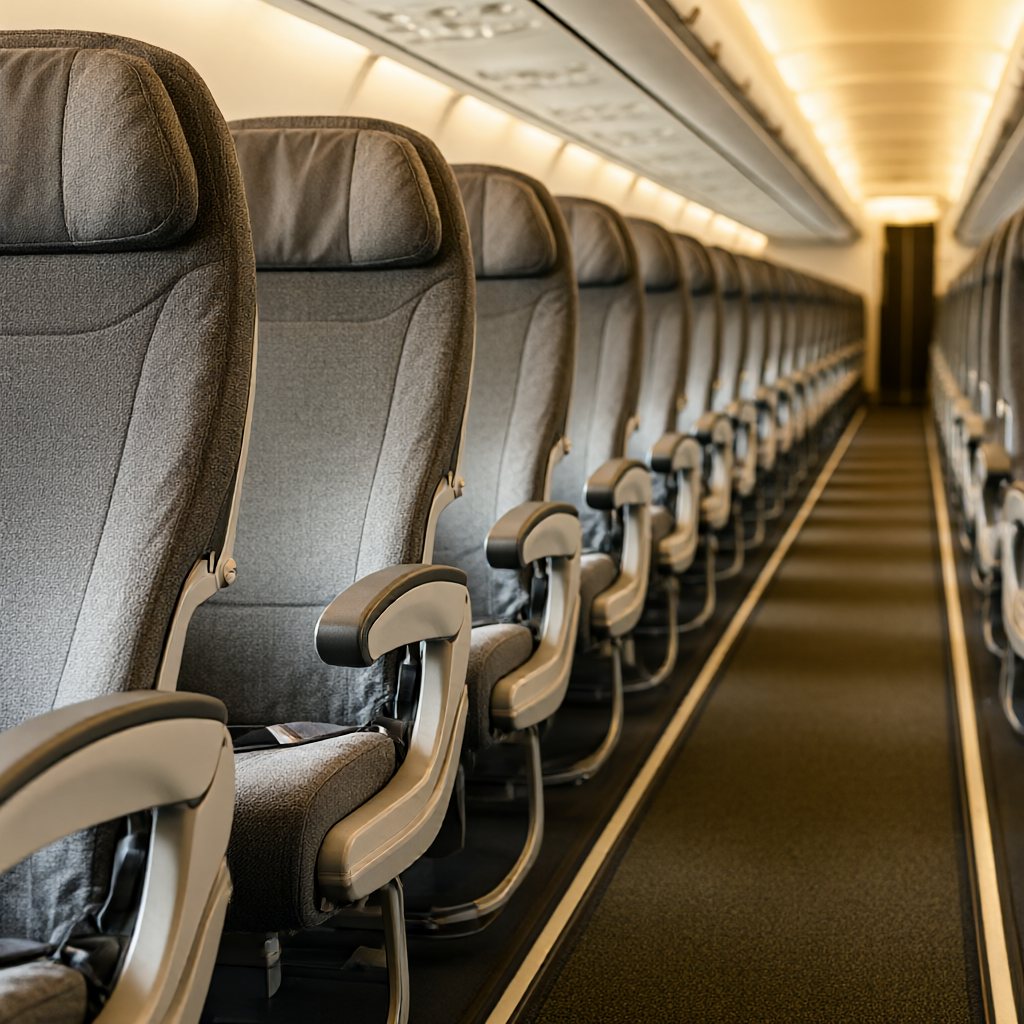
For plus-size passengers, the physical fit of an aircraft seat is not a comfort preference but a safety requirement. The FAA requires that every passenger be able to buckle the seat belt and keep both armrests fully down. If a passenger cannot lower the armrest, the airline may require a second seat. The practical question is not whether you will fit, but which aircraft type and seat position give you the highest chance of meeting these requirements without extra cost.
Seat Width by Aircraft Type
Economy seat width varies more by aircraft model than by airline brand. The widest standard economy seats measure approximately 17.8 to 18.4 inches, while the narrowest fall between 16 and 17 inches. This difference of up to 2.4 inches can determine whether the armrests lower fully or whether you need to request a different seat.
Wide-body aircraft such as the Boeing 777 and Airbus A350 generally offer wider economy seats than narrow-body planes like the Boeing 737 or Airbus A320. However, seat width also depends on seat configuration. A 3-3 layout on a narrow-body aircraft typically yields seats around 17 inches, while a 2-4-2 layout on a wide-body aircraft can provide 18 inches or more.
Before booking, check the aircraft type for your specific flight. Many airline websites list seat width in the seat map or aircraft information section. The FAA requires carriers to disclose the narrowest and widest passenger seat width for each class of service, so this data is available for every flight operated under Part 121 rules. If the seat width is not visible, call the airline and ask for the seat width for your flight's aircraft model.
Choosing the right aircraft type can be more impactful than selecting a premium seat. An 18.4-inch seat on a wide-body aircraft may provide sufficient hip room without an upgrade, while a 16.5-inch seat on a regional jet may require a second seat even if you book an exit row.
Seat Belt Extender Rules
Standard aircraft seat belts measure 40 to 45 inches in total length. A seat belt extender adds 10 to 25 inches, depending on the airline and the specific extender type. Extenders are provided free of charge by cabin crew on request. No weight threshold, medical documentation, or advance notification is required.
Passenger-owned extenders are not permitted on US flights. The belt hardware on aircraft is specific to each airline and seat model, so only airline-issued extenders can be used. The cabin crew carries a limited number of extenders on each flight, so requesting one early is advisable. You can ask for an extender at boarding, or you can notify the gate agent before boarding to ensure availability.
The extender must be attached by a flight attendant. You should not attempt to attach it yourself, as the hardware is designed for specific seat models. Once attached, the extender adds length to the belt without compromising the buckle's structural integrity. The extender does not change the seat width or the armrest position.
If you need an extender on a flight, the airline will not charge a fee. The extender is considered part of the safety equipment on board, and airlines are required to accommodate passengers who cannot fasten the standard belt. If the crew does not have an extender available, they may move you to a seat with a longer belt or to a seat with more space.
Armrest-Down Test
The armrest-down test is the clearest practical check for seat fit. You must be able to lower both armrests completely to the down position while seated. If an armrest cannot be lowered, the seat is not considered usable for you, and the airline may require you to purchase or be assigned a second seat.
The armrest test applies to every seat on the aircraft, including exit row seats and bulkhead seats. Some exit row seats have armrests that are fixed in the upright position, which may not meet the requirement. The test is not about comfort; it is about ensuring that the seat belt can be secured and that the seat is safe for takeoff, landing, and turbulence.
When you board, perform the armrest test before the aircraft doors close. If the armrest does not lower, ask the flight attendant for assistance. They may be able to move you to a different seat with a wider configuration or a different seat model. If no seat is available, the airline may require you to book a second seat for that flight.
The armrest-down test is also relevant for passengers who do not use a seat belt extender. Even if the belt buckles, an armrest that cannot lower indicates that the seat is too narrow for your hip width. This can affect your safety during turbulence, as the armrest provides lateral stability.
Single-Cabin-Seat Booking
When a standard seat does not accommodate your hip width, booking a single cabin seat is the next step. A single cabin seat means you purchase two adjacent seats, but only occupy one. This gives you the width of two seats, allowing you to lower both armrests and buckle the belt without pressure.
Airlines handle single-seat booking differently. Some require you to call reservations to book a second seat, while others allow you to book two seats online. In most cases, the second seat is sold at the same fare as the first seat. Some airlines offer a discount or a refund for the second seat if the flight is not full, but this policy varies by carrier.
The single-seat booking is not the same as booking an extra legroom seat. The extra seat provides lateral space, not just additional legroom. For passengers with hip breadth exceeding the seat width, the extra seat is the only way to meet the armrest-down requirement without relying on an extender.
Before booking a second seat, confirm the airline's policy on refunds and seat selection. Ask whether the second seat can be adjacent to your original seat and whether it will be counted as occupied for weight and balance purposes. Some airlines require the second seat to be booked in the same passenger name and may issue a separate boarding pass.
Exit Row Aisle Seats
Exit row aisle seats often provide the most added room without an upgrade fee. The aisle side of an exit row seat has no seat next to it, which allows you to angle your legs and torso into the aisle. This can reduce hip pressure and allow the armrest to lower more easily.
However, exit row seats are not always wider than other economy seats. The seat width is the same as in the rest of the cabin. The advantage is the additional legroom and the open space beside the seat, not a wider seat pan. For passengers who need extra hip width, the aisle seat in an exit row may still not be sufficient.
Exit row seats also have specific safety requirements. You must be able to assist in an emergency, and the armrest must be in the down position for takeoff and landing. If you cannot lower the armrest, you will not be allowed to sit in the exit row, even if you booked the seat.
Practical Checklist Before Booking
Before you book a flight, use this checklist to determine whether the seat will meet your needs.
First, identify the aircraft type for your flight and look up the seat width. Compare that width to your hip breadth. If your hip breadth is more than 1 inch wider than the seat width, plan to request a seat belt extender and prepare to perform the armrest test at boarding.
Second, select an aisle seat if possible. An aisle seat gives you the option to shift your hips slightly into the aisle, which can help lower the armrest. Avoid middle seats and window seats, as they restrict lateral movement.
Third, request a seat belt extender from the cabin crew as soon as you board. Do not wait until after takeoff. If the crew does not have an extender, ask to be moved to a seat with more space or a different seat model.
Fourth, if you know that your hip width exceeds the widest economy seat by 2 inches or more, book two seats in advance. Confirm the airline's policy on second seats, including the cost, refund conditions, and whether the second seat can be adjacent.
Fifth, check whether the exit row aisle seat is available for your flight. If the exit row is not wider than the standard seat, the extra legroom alone may not solve the armrest issue. Weigh the trade-off between exit row legroom and aisle access before selecting a seat.