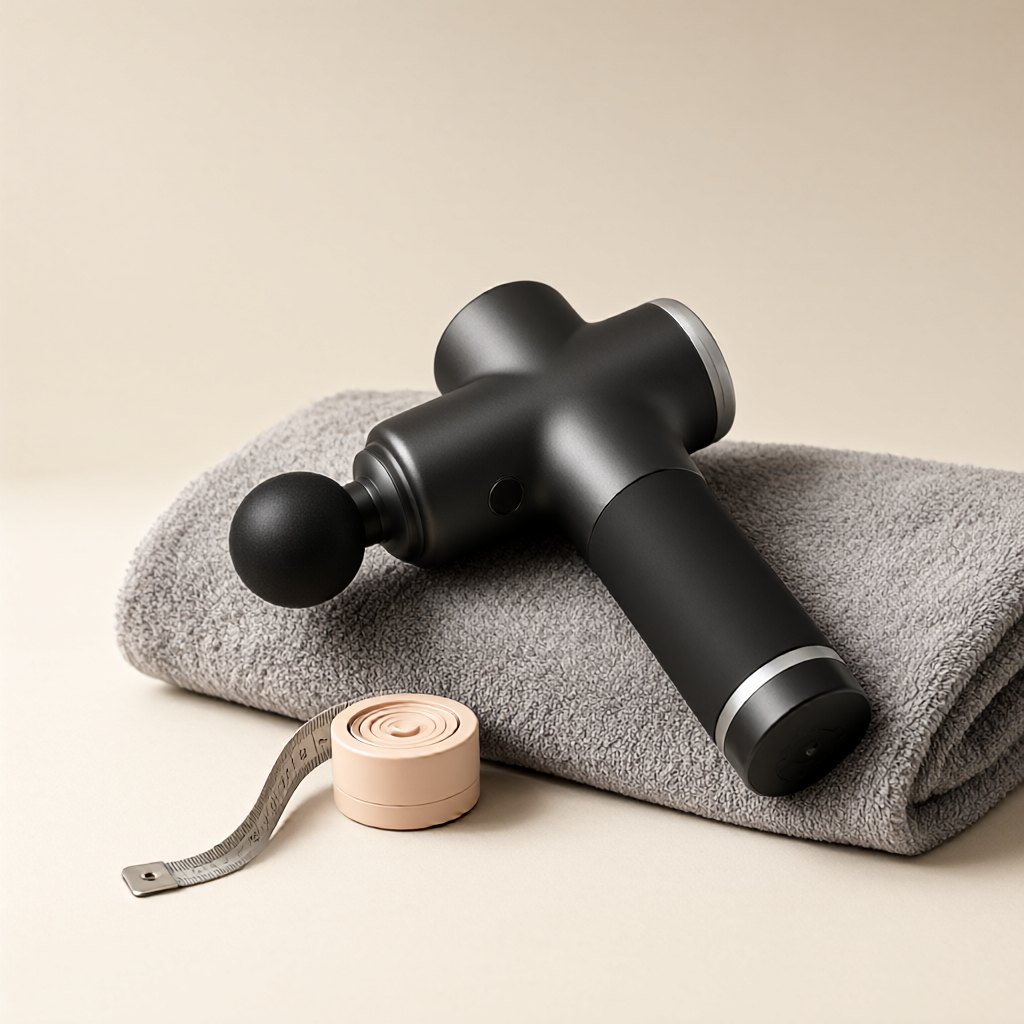
Standard massage guns fail for larger bodies because their motors stall against dense tissue and their handles lack the length required to reach the lower back or legs without shoulder strain. Selecting a functional device requires checking three specifications: stall force, handle reach, and device weight. A gun that stalls under moderate pressure provides no muscle relief, and a short handle forces awkward arm angles that cause joint fatigue.
Motor Stall Force and Pressure Control
Stall force measures the pounds of pressure a motor withstands before stopping. Devices rated under 30 pounds of stall force stop when pressed into thick glute or shoulder tissue. A rating of 40 to 60 pounds of stall force maintains percussion depth under firm pressure. Amplitude, the distance the head travels back and forth, determines depth of penetration. An amplitude of 10 to 12 millimeters reaches deep tissue layers; lower amplitudes only vibrate the skin surface.
Applying pressure requires arm strength and leverage. Heavier guns with high stall force demand less downward force from the user because the motor does the work. Lighter guns require the user to push harder to achieve the same tissue depth, transferring strain to the wrist. Test a motor by pressing the gun into a firm mattress; if the motor pitch drops and the head slows, the stall force is insufficient for deep tissue work.
Handle Length and Arm Reach
Reaching the mid-back, glutes, and hamstrings requires a handle length that allows a straight arm. Standard handles measure 4 to 5 inches, forcing the wrist into a sharp bend and the shoulder into internal rotation when reaching backward. A handle length of 6 to 7 inches from the trigger to the head pivot point allows a neutral wrist position and reaches the lumbar area without straining the rotator cuff.
Multi-grip or adjustable-angle handles solve reach limitations. Angled handles, typically set at 135 to 145 degrees, align the arm naturally when reaching the posterior chain. Tri-handle designs, featuring a horizontal bar across the motor, provide leverage for pulling the gun into the back rather than pushing. Measure reach by holding the gun at the trigger and extending the arm backward; the massage head should reach the opposite shoulder blade without shrugging the shoulder.
Device Weight and Grip Circumference
Device weight dictates session duration. A gun weighing over 2.5 pounds causes forearm fatigue within three minutes when held at arm's length. Devices between 1.5 and 2.2 pounds balance motor mass and handling ease. Weight distribution matters more than total weight; motors positioned near the handle reduce wrist torque, while motors at the head end create a lever effect that pulls the wrist downward.
Grip circumference affects hand fatigue for larger hands. A handle diameter under 1.5 inches forces a pinched grip, restricting blood flow and causing cramping. A diameter of 1.75 to 2 inches allows a full wrap grip, distributing weight across the palm. Rubberized or textured silicone coatings prevent slippage when hands sweat, requiring less grip strength to maintain control.
Attachment Heads for Dense Tissue
Attachment head shape determines force concentration. Flat heads distribute pressure over a wide area, preventing bruising on sensitive tissue. Bullet heads concentrate force onto a point, suitable for trigger points but risky on large muscle bellies if the user presses hard. Fork heads fit around tendons but often lack the width to clear larger limb circumferences.
Large-diameter heads, measuring 1.5 inches or more across the surface, suit larger bodies. A wider surface area prevents the head from sinking too deeply into soft tissue gaps. Foam-padded heads deform under pressure, reducing peak force; rigid plastic heads transmit full motor force. For dense glute or thigh tissue, a rigid large flat head penetrates effectively without catching on skin.
Speed Settings and Recovery Application
Revolutions per minute regulate the pace of muscle stimulation. High speeds, ranging from 2400 to 3200 RPM, desensitize nerve endings and suit large muscle groups like the quadriceps. Low speeds, between 1200 and 1800 RPM, suit joints and tender areas. A gun with three distinct speed settings provides adequate range; five or more settings offer negligible functional difference.
Recovery protocols for larger bodies require longer application durations per muscle group due to tissue volume. A standard session targets a single muscle group for 60 seconds; dense tissue requires 90 to 120 seconds at moderate speed with firm pressure. Moving the gun slowly across the muscle, at a pace of one inch per second, allows the tissue to adapt to the percussion.
Plus Size Massage Gun Fit Checklist
Verify stall force rating exceeds 40 pounds for deep tissue penetration. Measure handle length at 6 inches or greater for posterior chain reach. Confirm device weight falls between 1.5 and 2.2 pounds for extended use. Check grip circumference allows a full hand wrap without pinching. Select large-diameter rigid flat heads for dense muscle groups. Test motor consistency by pressing the running gun into a firm surface to ensure speed does not drop.