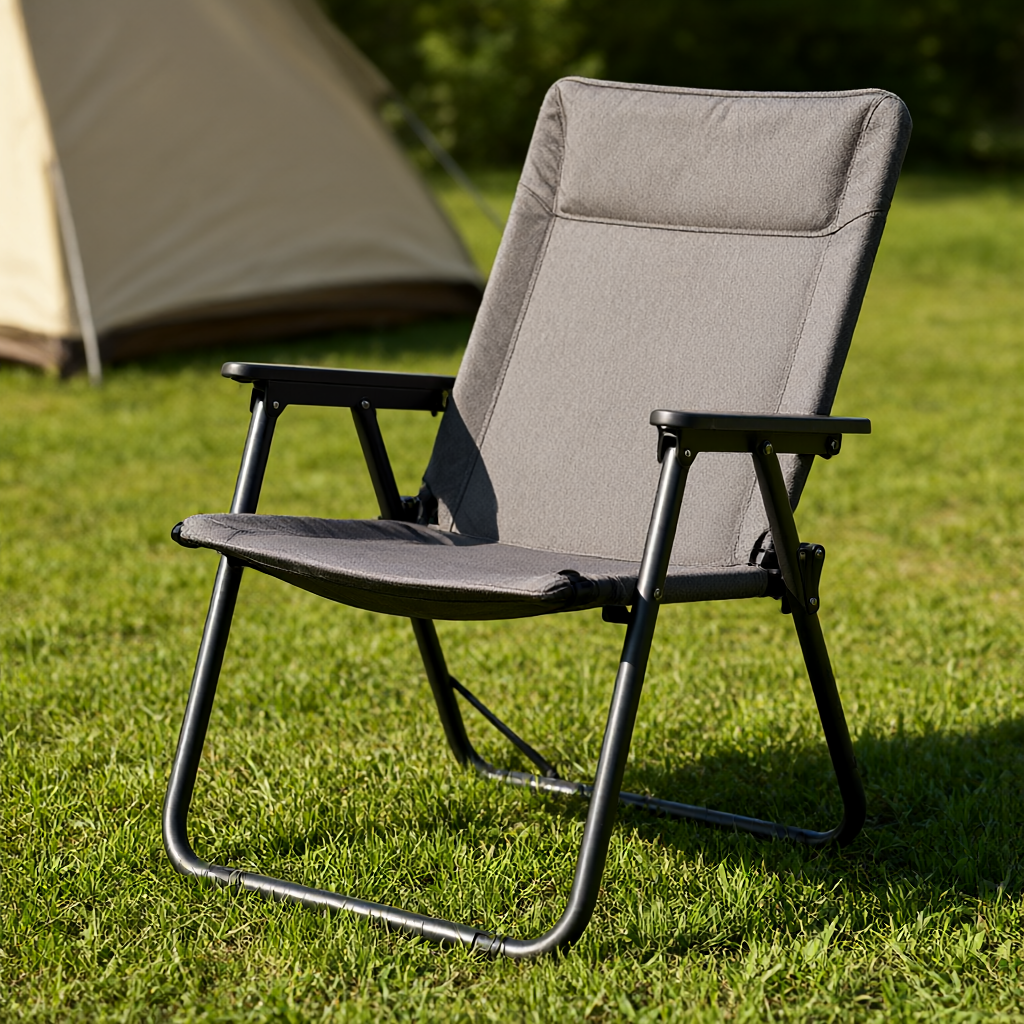
Selecting a camping chair for a larger body requires matching seat dimensions and structural capacity to the user's weight and hip width. Standard camp chairs restrict at the hips, compress the thighs, and risk frame collapse under load. A suitable chair must provide a seat width exceeding the user's seated hip span, a weight rating with adequate margin, and a frame geometry that prevents tipping.
Seat Width and Depth Measurements
Measure seated hip width by sitting on a flat surface and measuring the distance across the widest point of the hips or thighs. Add a minimum of two inches to this measurement to determine the required seat width. A chair with a 20-inch interior seat width accommodates a seated hip span up to 18 inches without lateral compression. Seat depth affects thigh support and circulation. A depth of 18 to 20 inches supports the thighs without pressing into the back of the knees. Deeper seats require leaning back to reach the backrest, which reduces upright support.
Seat edge height dictates the angle of the knees and the effort required to stand. A seat height of 15 to 17 inches positions the knees at a 90-degree angle for users with shorter leg lengths, while a height of 18 to 20 inches reduces knee flexion for longer legs. Lower seats increase the physical effort needed to exit the chair. Fabric sag alters effective seat depth. When sat upon, non-taut fabric pools the user backward, shifting weight off the thighs and onto the tailbone. Select chairs with reinforced fabric panels or tension straps beneath the seat to maintain a level sitting surface.
Weight Rating and Frame Capacity
Manufacturers assign static weight ratings based on distributed loads applied to the seat center. These ratings do not account for dynamic forces generated when sitting down or shifting weight. Select a chair with a weight rating at least 25 percent higher than the user's body weight. A 300-pound user requires a chair rated for a minimum of 375 pounds. Steel frames provide high load capacity but add carrying weight. Aluminum frames reduce weight but require thicker tubing or reinforced joints to match steel capacity. Examine the joint connections; riveted joints loosen under repeated stress, whereas welded joints maintain structural integrity under heavy loads.
Frame legs determine load distribution on soft ground. Quad-leg designs distribute weight across four contact points, reducing ground penetration on dirt or sand. X-frame designs concentrate weight on two primary points and are prone to sinking unless equipped with wide foot caps. Test frame rigidity by grasping two opposite top rails and twisting. Lateral flex indicates weak joint welds or undersized tubing. Cross-support bars located midway up the legs prevent splaying under load. Chairs lacking these bars rely solely on the fabric seat to hold the frame together, which accelerates fabric tearing under high stress.
Armrest Height and Entry Clearance
Armrests must support the forearms without shrugging the shoulders. Measure the distance from the seat to the underside of the forearm while sitting upright. An armrest height of 8 to 10 inches above the seat pad suits most users. Padded armrests reduce pressure on the ulnar nerve but compress over time. Hard plastic or metal armrests maintain height but require a fabric cover to prevent skin adhesion in warm conditions. Armrests that flip up or rotate outward widen the entry path, allowing the user to slide into the seat laterally rather than stepping over the frame.
Entry clearance is the vertical distance between the front support bar and the seat edge. Low front bars obstruct the lower legs during the sitting motion, causing the shins to impact the metal. Chairs designed with a curved or elevated front bar remove this obstruction. The distance between the armrest posts must exceed the user's seated hip width. Narrow armrest posts force the user to squeeze into the seat, which compresses the torso and restricts arm movement. Measure the interior distance between the armrests rather than the overall chair width to verify entry space.
Backrest Angle and Lumbar Support
Camping chair backrests range from upright to deep recline. Upright angles near 100 degrees facilitate eating and conversation but transfer more weight to the ischial tuberosities. Reclined angles near 110 degrees distribute weight across the backrest, reducing seat pressure. A backrest height of 24 to 26 inches supports the thoracic spine and shoulders. Shorter backrests end at the mid-back, offering no upper body support and causing the shoulders to round forward.
Lumbar support in folding chairs relies on fabric tension and internal stays. Flat backrests allow the lower back to flatten, straining the lumbar discs. Chairs with a sewn-in lumbar pad or a curved frame crossbar at the lower back region maintain the spine's natural inward curve. The pad must align with the user's lumbar region, typically 6 to 8 inches above the seat. Adjustable tension straps on the backrest allow the user to increase or decrease lumbar firmness by pulling or releasing the webbing.
Stability on Uneven Terrain
Chair stability depends on the base footprint and the center of gravity. A wider base footprint prevents tipping when the user shifts weight to one side. Measure the distance between the outer edges of the feet at the front and back. A base depth greater than 20 inches resists forward tipping when the user leans to stand. Anti-sink foot attachments increase the surface area of the contact points. Flat plastic caps perform on packed dirt, while wide mesh platforms or oversized rubber cups prevent sinking in sand and mud.
Rocking or gliding mechanisms introduce pivot points that shift the center of gravity. These mechanisms require a flat, hard surface to function without lateral drift. On uneven terrain, pivoting chairs settle at the lowest point, tilting the user sideways. Lock the gliding mechanism on sloped ground to fix the frame position. Avoid chairs with narrow rocker bases on soft ground, as the curved rails dig into the soil and restrict motion. Verify ground contact by placing the chair on a flat surface and pressing down on all four corners; lifting indicates frame warping, which causes instability on natural surfaces.
Pre-Purchase and Setup Checklist
Verify the interior seat width exceeds seated hip span by two inches. Confirm the weight rating is 25 percent above body weight. Measure armrest interior clearance for unobstructed entry. Check for welded joints and mid-leg cross-support bars. Ensure the backrest height reaches the shoulders. Confirm the front crossbar sits below shin clearance height.
Inspect fabric attachments for reinforced stitching at stress points. Test the frame for lateral flex before loading. Attach anti-sink foot platforms for soft ground use. Adjust backrest tension to support the lumbar curve. Lock any gliding mechanisms before sitting on uneven surfaces.