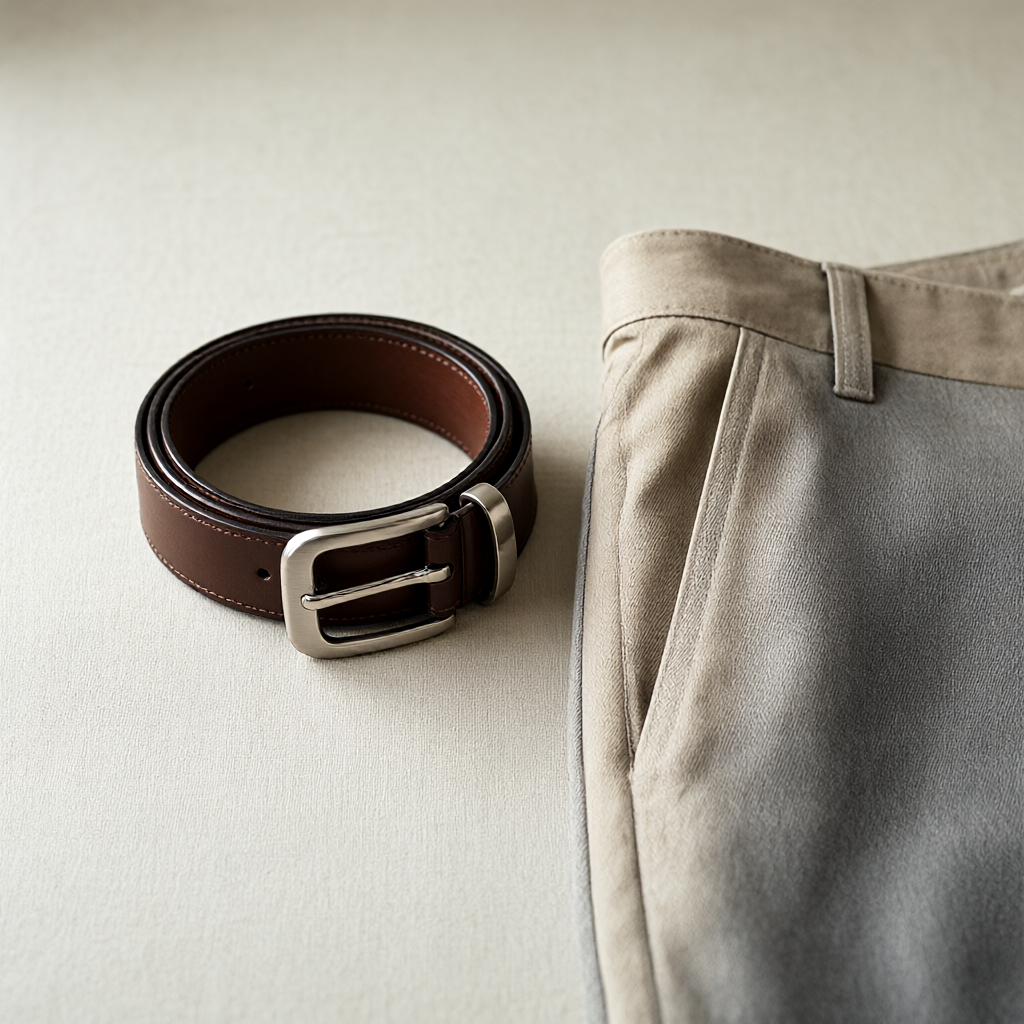
Selecting a belt for a larger midsection requires evaluating three structural factors: true waist circumference over clothing, hardware durability relative to pant loops, and material elasticity for seated expansion. Standard belts fail when they lack sufficient hole spacing, use hinges rated for lower tension, or provide no stretch during prolonged sitting. A functional belt accommodates waist fluctuations without digging into the abdomen or sagging under garment weight.
Waist Measurement Over Clothing
Measure the waist wearing the specific pants the belt will accessorize. Thread a flexible measuring tape through the belt loops and note the circumference at the midpoint of the loops. This measurement accounts for the fabric bulk of the pants, which adds inches compared to a bare waist measurement. Record this number in inches to establish the target belt length.
Belt sizing conventions vary by manufacturer. Some brands size belts from the buckle prong to the middle hole, while others measure from the buckle prong to the end of the strap. Use the measured waist circumference as the middle-hole length. A belt with five holes spaced one inch apart provides a two-inch adjustment range on either side of the center, accommodating weight fluctuation and layering changes.
Verify the strap length beyond the center hole. When fastened at the center hole, the tail of the belt must extend far enough to tuck securely into the first belt loop past the buckle. A tail shorter than four inches slips out during movement, while a tail longer than eight inches creates a bulky protrusion. Measure the distance from the center hole to the strap end to confirm this tail length falls within the four-to-eight-inch range.
Buckle Width and Hinge Durability
The buckle width must align with the pant belt loops. A buckle wider than the loop gap will not thread through, forcing the loop to stretch or tear. A buckle narrower than the loop gap allows lateral shifting, which twists the belt and creates uneven pressure on the waistband. Measure the inside width of the pant loops and select a buckle width that matches this dimension within a quarter-inch tolerance.
Hinge durability determines load capacity under abdominal pressure. Standard single-hinge buckles with thin metal pins bend or snap when subjected to the tension of a larger midsection, especially when sitting. Inspect the buckle hinge mechanism. A roller buckle features a cylindrical bar that the strap wraps around, reducing friction and preventing the leather from creasing and cracking under high tension. A double-prong buckle distributes closing force across two points, reducing the strain on the hinge pin.
Evaluate the buckle plate thickness. A plate thinner than two millimeters deforms under sustained pressure, causing the prong to misalign with the holes. Test the prong rigidity by attempting to bend it with moderate finger pressure. A prong that flexes easily will eventually fail to stay seated in the hole, leading to unfastening. Prioritize solid brass or stainless steel components over plated zinc alloys, which chip and weaken at the stress points.
Stretch and Elastic Hybrid Materials
Rigid leather or synthetic straps restrict abdominal expansion when sitting, compressing the stomach and causing discomfort. Elastic inserts or stretch hybrid materials accommodate this expansion. A stretch belt contains elastic panels woven into the strap or features a core elastic band encased in leather or fabric. This construction allows the belt to expand up to two inches when seated, maintaining pant support without constriction.
Assess the elastic recovery rate. A belt that stretches but does not retract fails to hold the pants up after standing. Test the recovery by stretching the strap to its maximum length and releasing it. The strap should return to its original length within seconds without visible waviness or permanent deformation. Elastic belts with a non-stretch leather or vinyl overlay provide the aesthetic of a traditional belt while retaining the functional stretch of an elastic core.
Prevent belt roll by checking the strap width and stiffness. A strap narrower than one and a half inches rolls over at the top and bottom edges under abdominal pressure, creating a rope-like cord that digs into the waist. A strap width of one and three-quarter inches or two inches distributes pressure across a broader surface area, preventing roll. Additionally, a strap with a semi-rigid core maintains a flat profile against the body, even when the elastic components engage.
Hole Spacing and Strap Thickness
Standard hole spacing of one inch restricts adjustability for bodies with fluctuating waistlines or varying clothing layers. Belts with half-inch hole spacing provide micro-adjustments, allowing the wearer to find a precise fit between standard increments. Custom hole punching allows the addition of holes where needed. Use a leather punch to add holes half an inch past the existing range, maintaining the original hole diameter and spacing pattern for consistent prong engagement.
Strap thickness affects both flexibility and hole integrity. A strap thicker than four millimeters resists bending around the waist, creating a stiff circle that gaps at the back and presses sharply at the front. A strap thinner than two millimeters stretches under tension, causing the holes to elongate and the prong to slip out. A thickness between two and a half to three and a half millimeters provides sufficient rigidity to prevent hole elongation while remaining pliable enough to conform to the body contour.
Reinforced holes prevent tearing under high tension. Inspect the hole edging for metal grommets or thick stitched borders. Unreinforced punched holes in stretch materials or thin leather tear outward under abdominal pressure, rendering the belt unusable. Grommets distribute the prong tension across a larger surface area, preventing the material from ripping. If adding custom holes to an unreinforced strap, install press-in grommets to match the factory holes and preserve the structural integrity.
Plus Size Belt Fit Checklist
Verify waist measurement is taken over the specific pants and matches the belt center hole length. Confirm the belt tail extends four to eight inches past the fastened hole. Ensure the buckle width aligns with the inside width of the pant loops within a quarter-inch tolerance. Check that the buckle hinge features a roller or double-prong mechanism and a plate thickness exceeding two millimeters. Validate that elastic hybrid belts recover to original length without permanent deformation. Confirm the strap width is at least one and three-quarter inches to prevent rolling. Check hole spacing for half-inch increments or plan for custom hole punching with grommets. Verify strap thickness falls between two and a half and three and a half millimeters for balance of flexibility and hole integrity.