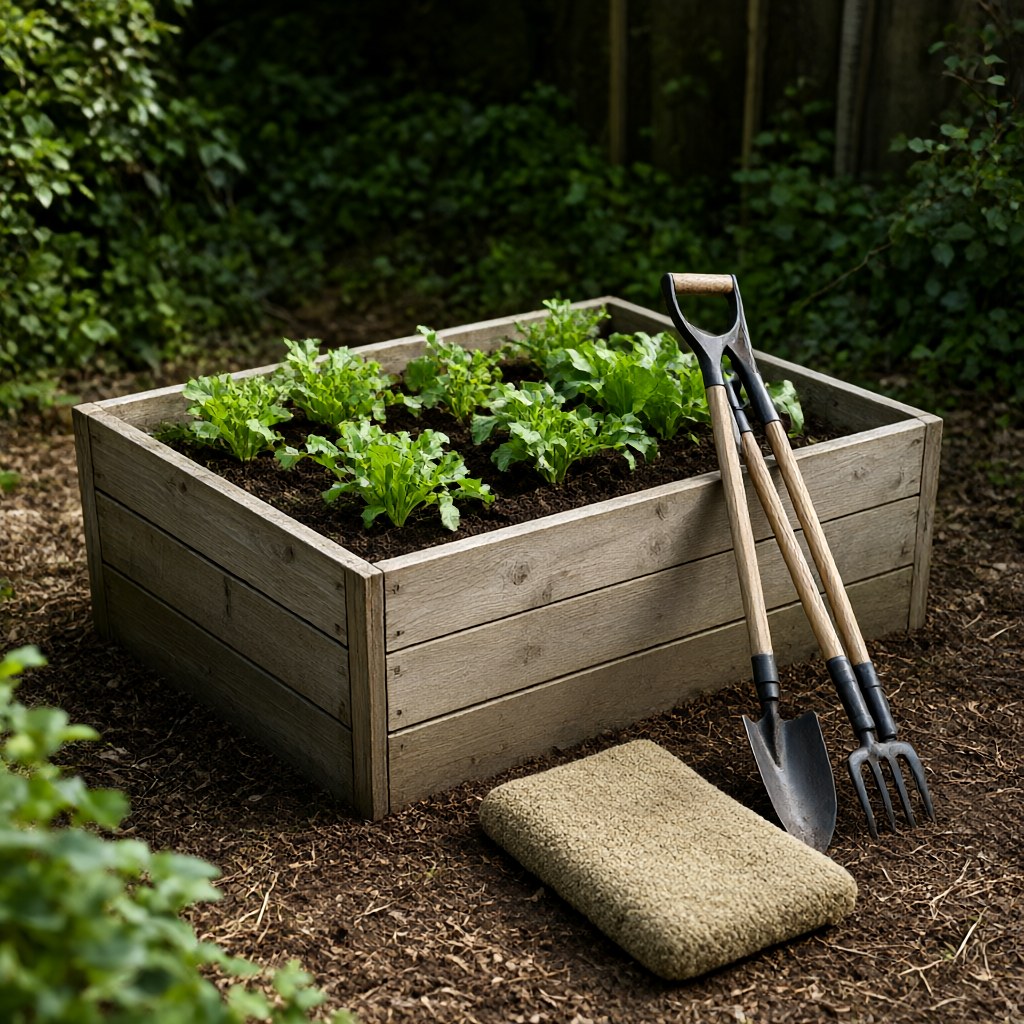
Building a raised bed garden for a plus size body requires specific dimensional adjustments to standard plans. Standard bed heights, narrow paths, and small tool grips create barriers that increase bending strain, restrict movement, and accelerate hand fatigue. A functional plus size gardening setup uses elevated bed heights between 24 and 36 inches, limits reach depth to 24 inches, mandates 36-inch pathways, and specifies tool handle diameters from 30 to 40 mm. These parameters align the garden with the physical reach and load tolerances of larger bodies, reducing musculoskeletal demand during repetitive tasks.
Raised Bed Height for Standing and Seated Access
Standard raised beds built 10 to 18 inches tall require deep bending or kneeling, which places high compressive loads on the knees and lower back for plus size individuals. For standing gardeners, a bed height of 24 to 30 inches elevates the soil surface to a comfortable working level, similar to standard kitchen countertop height. This range minimizes trunk flexion and allows tending plants without bending past 20 degrees. Constructing beds at the upper end of this range, around 30 to 32 inches, accommodates taller individuals and further reduces spinal loading during prolonged weeding or planting sessions.
Seated gardening, whether on a stool or in a wheelchair, demands a higher bed to provide adequate leg room underneath the structure. Beds for seated access must be 30 to 36 inches tall. A cantilevered design is required to allow the knees and wheelchair footrests to slide under the bed edge. This design necessitates a minimum knee clearance of 27 inches in height from the ground to the underside of the bed rim. The structural integrity of a cantilevered bed relies on secure anchoring of the overhanging rim to the support legs, preventing tipping when downward force is applied to the outer edge.
Bed Width and Maximum Reach Limits
The width of a raised bed must correspond to the maximum horizontal reach distance to avoid overextension and loss of balance. Most individuals can reach approximately 24 inches into a bed from a stationary position at the edge without leaning onto the soil or stepping into the bed. Stepping into the bed compacts the soil and creates unstable footing, which poses a higher fall risk for plus size gardeners. Consequently, a freestanding bed accessible from both sides should have a maximum width of 4 feet, ensuring the center remains within the 24-inch reach zone from either edge.
Beds positioned against a wall or fence are accessible from only one side, requiring a depth restriction. A single-access bed must not exceed 24 inches in width. Extending the width beyond this limit forces the gardener to stretch beyond their base of support, increasing shear forces on the lumbar spine and requiring lateral bending to reach the back of the bed. Maintaining the 24-inch maximum reach parameter across all bed configurations ensures that all planting, harvesting, and maintenance tasks occur within the functional reach envelope.
Pathway Width and Maneuvering Space
Pathway dimensions between raised beds dictate the ease of navigation and the ability to turn safely. Standard garden paths at 18 or 24 inches wide restrict hip and shoulder clearance, forcing plus size gardeners to turn sideways or walk at an angle. A minimum pathway width of 36 inches provides adequate clearance for forward movement and accommodates the turning radius required to pivot between beds without stepping into the soil. This 36-inch dimension aligns with standard accessible route requirements, providing continuous maneuvering space without pinch points.
At intersections where two paths cross, or where a path dead-ends and requires a 180-degree turn, additional space is necessary. A 36-inch wide T-shaped intersection allows a straight forward approach and turn, but a dead-end requires a turning radius of at least 60 inches for a wheelchair or a wider stance turn. For plus size individuals who use a rolling garden seat or a standard wheelchair, maintaining a 36-inch path width along all route segments and a 60-inch turning space at all terminations prevents the need to back up long distances to exit the garden area.
Tool Handle Grip Diameter and Hand Load
Tool handle diameter directly affects grip force production and muscle fatigue in the hand and forearm. Ergonomic research on cylindrical handles in maximum gripping tasks identifies a 35 mm diameter as the most comfortable size, followed closely by 40 mm. Handles measuring 25 or 30 mm require higher finger flexion force, which drives higher flexor muscle activity and accelerates fatigue during repetitive motions like digging or pruning. For plus size hands, selecting tools with handle diameters between 30 and 40 mm balances grip strength capability with comfort, utilizing a handle circumference to hand length ratio near 64 percent.
Occupational health guidelines for single-handle hand tools specify a diameter range of 30 to 40 mm to maintain a neutral wrist position during operation. Dual-handle tools, such as pruners or loppers, must start with an initial span of less than 100 mm and close to a terminal span of 40 to 50 mm to avoid overstretching the fingers. Handle length must be at least 100 mm, with 125 mm providing better support for the entire palm. When wearing gloves, handle length should not be shorter than 125 mm to accommodate the added bulk. Hooked or angled handles require a diameter of 30 to 55 mm to maintain the power grip posture without wrist deviation.
Kneeling Mechanics and Grip Load Checks
Kneeling places high compressive and shear forces on the knee joints, which are amplified in plus size bodies due to higher body mass. When kneeling on the ground, the body's center of mass shifts forward, requiring substantial quadriceps and core activation to return to a standing position. Raised beds at 24 to 36 inches in height eliminate the need to kneel for ground-level tasks. If a task requires temporary kneeling, such as weeding a low border outside the raised bed, using a thick kneeling pad of at least 2 inches reduces pressure on the patella, but the exertion required to stand back up remains a limiting factor. Prioritizing standing or seated postures within the raised bed system avoids this high-load transition.
Verifying the grip load during tool use involves checking the wrist angle and forearm exertion. The wrist must maintain a neutral position during the power grip, avoiding ulnar or radial deviation. A handle that forces the wrist into flexion or extension transfers the load from the larger forearm muscles to the smaller tendons in the carpal tunnel, increasing the risk of strain. To check grip load, hold the tool in the working position and observe the alignment of the forearm to the hand; a straight line indicates a neutral grip. If the wrist bends, the tool handle angle or length requires adjustment to bring the working surface in line with the forearm axis.
Setup Verification Checklist
Measure standing bed height at 24 to 30 inches from ground to soil surface. Measure seated bed height at 30 to 36 inches with at least 27 inches of open knee clearance underneath. Confirm freestanding bed width does not exceed 48 inches and single-access bed width does not exceed 24 inches. Verify all pathway widths measure at least 36 inches, with 60-inch turning radius at dead ends. Check all single-handle tool diameters fall within the 30 to 40 mm range. Confirm dual-handle tool starting span is under 100 mm and closing span is 40 to 50 mm. Verify handle lengths are at least 125 mm for gloved use. Observe wrist position during tool grip to ensure a neutral, unbent alignment from forearm to hand.