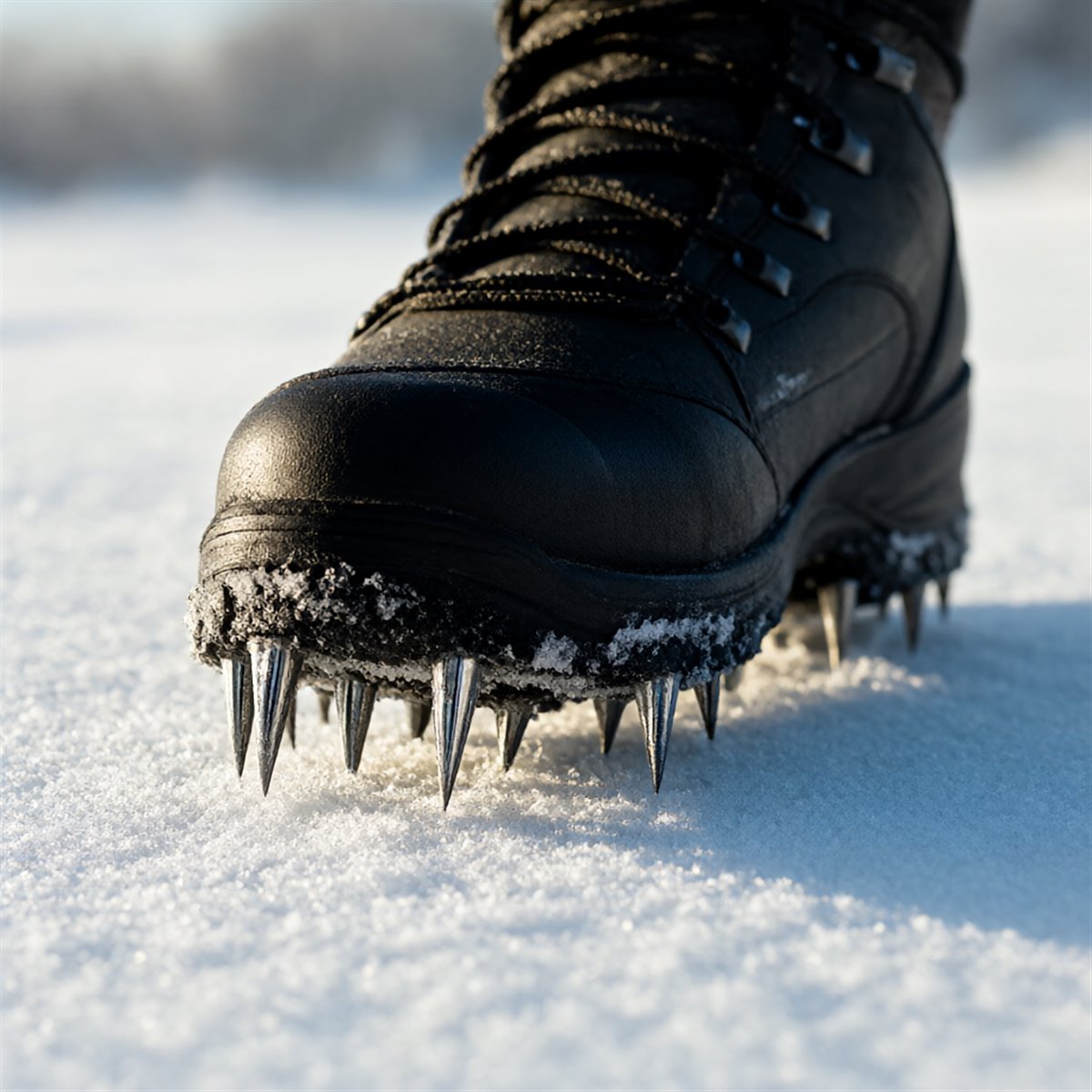
Plus size winter traction cleats attach to footwear rather than the body, making shoe length the sole determinant for sizing. A person wearing a men's size 13 boot needs an X-Large cleat regardless of body weight, while someone in a women's size 7 shoe requires a Medium. Sizing charts map directly to footwear dimensions: Small fits men's 3-6, Medium fits men's 7-10.5 and women's 5-8, Large fits men's 11-12.5 and women's 8.5-11, and X-Large covers men's 13 and above. Footwear length in inches provides a secondary measurement axis, with Medium covering 11.75 to 12.25 inches and X-Large spanning 13.25 to 13.5 inches.
Between sizes, sizing up accommodates bulkier winter boots with thick insulation. Cleats stretch over the shoe toe first, then the heel strap pulls over the back. This elastic tension holds the device in place, but oversized insulated pack boots often exceed the strap's extension limit, requiring an optional bulky boot strap kit to maintain heel security. Sizing follows the external footprint volume, not the wearer's weight or calf circumference.
Sizing by Shoe Length and Bulky Boot Accommodation
Footwear length dictates cleat size because the device must stretch around the sole perimeter and toe box. Measuring the boot length in inches provides the most accurate mapping when shoe size varies by brand. A boot measuring 12.5 inches aligns with a Large cleat, while a 13.75-inch boot requires an XXL. Width adds secondary volume; a wide winter boot stretches the cleat bands horizontally, reducing the longitudinal stretch available for length. When a boot sits at the upper boundary of a size range, moving up one size prevents overstretching the rubber frame.
Insulated pack boots create a specific fit challenge because their ankle circumference and heel depth exceed standard footwear dimensions. Standard heel straps fail to clear the raised heel counter of a pack boot, causing the cleat to slip off during stride. An optional bulky boot strap kit replaces or extends the standard heel strap to accommodate this larger profile. These replacement straps adjust per size tier and attach to the existing cleat frame without tools. Without this extended strap, the cleat heel loop slides down the boot shaft, exposing the shoe sole to the ice surface.
Calf Strap Fit and Heel Security for Larger Legs
Heel strap tension, not calf circumference, secures a winter cleat to the foot. The strap stretches over the heel counter at the back of the shoe, anchoring the spike plate against the sole. Calf size does not interfere with this mechanism because the strap terminates at the shoe heel, well below the calf muscle. However, high-cut winter boots with wide shafts can push against the top of the cleat opening. If the boot shaft is too wide, it distorts the cleat's toe pocket, loosening the fit across the forefoot.
For high-back boots, the heel strap must stretch over a greater vertical distance. A standard strap may snap back or roll down if stretched beyond its designed limit. Upgrading to a cleat model with a reinforced or adjustable heel loop resolves this tension deficit. Some models feature a defined half-inch heel plate that aids stability on ladders and during shoveling; this rigid heel section requires precise strap alignment to prevent lateral shifting. Replacing worn heel straps before the elastic degrades maintains the grip required for safe winter walking on ice, packed snow, and frozen trails.
Spike Patterns and Replaceable Cleat Systems
Spike patterns scale from light grip to full-foot traction based on the number and arrangement of contact points. Light models use horizontal rubber coils or small embedded studs suitable for packed snow and pavement. Moderate models add steel coils or rivets across the heel and forefoot. High-traction models utilize full-foot plates featuring up to 34 replaceable steel cleats, providing grip on frozen trails and ice. A defined half-inch heel with 22 tungsten carbide studs targets specific slip zones during heel strike and when climbing ladders.
Replaceable spike models extend the usable lifespan of the traction device. As steel or tungsten carbide studs wear down on abrasive surfaces like pavement, individual cleats can be swapped out using an 8-piece replacement pack. This system prevents the need to discard the entire unit when only the heel spikes lose their penetration angle. Worn spikes lose their ability to bite into ice, causing the shoe to slide despite the traction frame being in place. Checking the spike height before each winter season identifies worn points that require replacement to maintain effective friction on frozen surfaces.
Sole Flex Checks and Indoor Removal Requirements
Sole flex determines walking comfort and spike contact consistency. A full-foot plate with fixed steel cleats limits forefoot bending, creating a rigid sole that can cause foot fatigue over long distances. Coil-based models and articulated spike plates allow the foot to flex naturally at the ball, reducing strain during the push-off phase of gait. When testing flex, bend the cleat at the midfoot; spikes should not disengage from their housings or scrape against each other. Rigid full-plate models suit stationary tasks like shoveling or short walks, while flexible frames suit active hiking or prolonged walking.
Exposed traction spikes damage indoor surfaces. Steel and carbide cleats scratch hard floors, polished tile, smooth stone, and metal. Traction devices must be removed before entering buildings, vehicles, or any indoor workspace. Pulling the heel strap forward and sliding the toe pocket off takes under a minute. Leaving cleats on indoors also dulls the spike points on hard abrasion-resistant floors, reducing their effectiveness on subsequent outdoor use. After removal, letting the cleats dry before storage prevents rust formation on the steel components and elastic degradation in the rubber frame.
Surface Conditions and Fall Prevention Mechanics
Winter traction cleats function on ice, packed snow, frozen trails, and mud. They do not provide grip on polished indoor tile, smooth stone, or metal surfaces. On slippery outdoor surfaces, the spikes penetrate the frozen layer, converting a low-friction interface into a stable walking platform. About one in three falls happen outdoors, often while simply walking or stepping onto a curb. Lightweight traction devices fitted over shoes prevent older adults from falling on ice and snow by restoring the friction coefficient that standard rubber or leather soles lack on frozen ground.
Falls remain the leading cause of fatal and nonfatal injuries among older adults, and footwear choice serves as a primary intervention. Rubber soles with deep treads provide better traction than leather or plastic soles, but tread alone cannot penetrate glare ice. Adding an external traction cleat introduces multiple hard contact points that fracture the ice layer under body weight. On slippery surfaces, leaning the body slightly forward and taking shorter strides reduces the horizontal force applied during each step, lowering the chance that the foot slides forward before the spikes set. Allowing extra time and using cleared, sanded, or salted pathways further reduces slip risk, but traction cleats provide the mechanical grip necessary when avoiding ice is impossible.
Pre-Season Cleat Readiness Checklist
Measure the winter boot length in inches and cross-reference with the cleat sizing chart, sizing up if the boot sits at the upper range boundary. Verify the heel strap clears the boot's heel counter without overstretching; order a bulky boot strap kit for insulated pack boots. Inspect all spikes for wear and replace worn studs using an 8-piece replacement pack where applicable. Test the sole flex at the forefoot to ensure the spike plate matches the intended walking distance and activity type. Wipe cleats dry after each use and store without moisture to prevent rust on steel components.