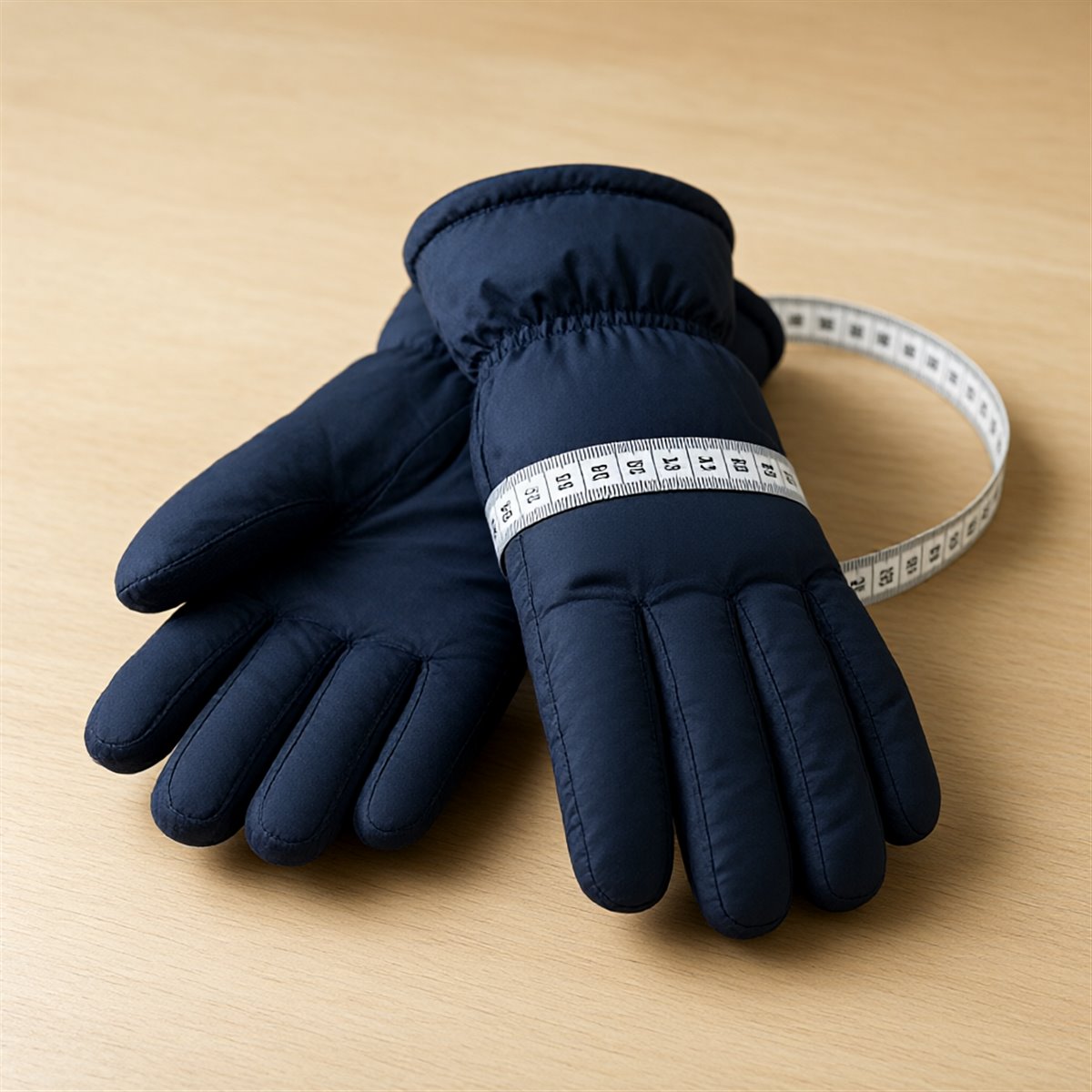
Plus size winter gloves require precise mapping of palm circumference and hand length to standardized sizing charts to prevent restricted blood circulation from tight fits or slippage from loose fits. Effective cold weather hand protection combines correct sizing with insulation weights matched to specific temperature ranges, waterproof membranes for sustained wetness, and cuff designs that seal the primary entry point for cold air and snow. Evaluating these structural variables ensures thermal resistance and manual dexterity without compression or gaps.
Palm Circumference and Hand Length Mapping
Glove size is determined by two measurements: palm circumference and hand length. Palm circumference is measured around the widest point of the palm excluding the thumb. Hand length is measured from the tip of the middle finger to the wrist crease. The larger of the two resulting size indications dictates the final glove size selection. For plus size requirements, sizes 10 through 12 accommodate larger dimensions. Size 10 corresponds to a 254-278mm palm circumference and 204-214mm hand length. Size 11 maps to 279-294mm circumference and 215-226mm length. Size 12 accommodates 295mm+ circumference and 227mm+ length.
Standard EN 420 sizing charts define minimum glove lengths corresponding to these hand measurements to ensure full finger and wrist coverage. A size 10 glove carries a minimum glove length of 260mm, size 11 requires 270mm, and size 12 extends further to cover the wrist crease adequately. Measuring both palm circumference and hand length is necessary because hand proportions vary; a wide palm with shorter fingers may require a size up from the circumference measurement alone, prioritizing width accommodation while accepting slight fingertip overflow over circulatory restriction.
Fit Tolerances and Circulation Factors
Too-small gloves restrict blood circulation and hand movement, which accelerates heat loss in cold environments despite high insulation values. Compression of blood vessels reduces the transport of warm blood to extremities, leading to cold fingers regardless of external thermal barriers. Conversely, too-large gloves slip during handling and reduce precision, creating safety hazards during grip-dependent tasks. Excess material at the fingertips traps air pockets that collapse under pressure, diminishing thermal resistance and allowing cold spots to form.
Plus size hand dimensions often involve wider palms without proportionally longer fingers, requiring fit assessment based on the larger circumference measurement. If palm circumference places the hand in size 11 but hand length aligns with size 10, size 11 is the correct selection to avoid lateral compression. Gloves constructed with four-way stretch materials or articulated finger gussets accommodate wide palms without requiring excessive overall volume, maintaining dexterity while preventing tightness across the metacarpal phalangeal joints.
Insulation Weight and Temperature Ranges
Insulation weight in grams per square metre dictates the thermal resistance of winter gloves. For temperatures between 20F and 30F, a minimum of 100g insulation provides adequate warmth for stationary or light activity. For subzero exposure, 200g+ insulation is required to maintain core hand temperature. Synthetic insulations such as Thinsulate, PrimaLoft, and Fiberfill retain thermal properties when damp, whereas down insulation loses effectiveness when wet unless treated with a hydrophobic coating. High insulation weights increase glove bulk, which affects grip circumference and lever operation.
Thermal resistance, measured as clo value, correlates directly with lining weight and thickness. Layering a liner glove under a primary shell increases total clo value without the stiffness of a single high-mass insulation layer. For plus size hands, ensuring the outer shell accommodates both the hand volume and the additional liner without circulatory compression is critical. The shell fabric, typically nylon or polyester with a durable water repellent treatment, must feature a high-denier weave to resist abrasion against the expanded interior volume that places outward tension on the material.
Waterproof Membranes and Lining Wicks
Waterproof membranes block liquid water while allowing vapour escape to prevent internal moisture accumulation. Membranes such as Gore-Tex, Hipora, or polyurethane films provide breathability rated in grams per square metre per 24 hours. A durable water repellent coating on the outer shell causes water to bead and roll off, but this coating alone fails under sustained wetness from wet snow or slush. For plus size gloves, the membrane must span the full width of the shell without seam leakage at the expanded stress points, particularly along the sidewalls of the fingers where wider hands exert outward pressure.
Internal linings of microfleece, tricot, or brushed polyester wick sweat away from the skin to prevent chilling during activity. The wicking mechanism relies on fabric contact with the skin; if the glove is too large, the lining loses contact and sweat pools, reducing thermal efficiency. If the glove is too small, the compressed lining cannot hold the air volume necessary for insulation. Proper plus size fitting ensures the lining conforms to the hand shape without stretching the fabric fibers to their limit, maintaining the micro-air pockets that trap heat.
Cuff Options and Closure Types
The cuff is the primary entry point for cold air and snow. Elastic knit cuffs seal at the wrist but may roll down or restrict circulation on larger forearms if the elastic band lacks sufficient stretch diameter. Hook-and-loop adjustable cuffs allow the wearer to cinch the opening over a jacket sleeve, sealing the gap between the glove and outerwear. This closure type accommodates varying forearm thicknesses by widening or narrowing the cuff aperture to match the wearer's dimension, preventing the sleeve from riding up and exposing skin.
Gauntlet cuffs with drawstrings extend up the forearm and are the most effective design for subzero conditions and deep snow. The gauntlet length must clear the jacket cuff by at least 50mm to ensure overlap during arm extension. For plus size individuals, the gauntlet diameter must accommodate thicker forearms without binding; a drawcord allows volume adjustment to seal out drafts while maintaining a comfortable fit. Short elastic cuffs are suitable for light activity in moderate cold, but gauntlet designs provide superior protection for prolonged exposure by blocking convective heat loss at the wrist gap.
Sizing Verification Checklist
Measure palm circumference at the widest point excluding the thumb using a flexible tape measure pulled snug but not compressing the skin. Record the measurement in millimeters and map it to the EN 420 sizing chart to find the corresponding size. Measure hand length from the tip of the middle finger to the wrist crease, mapping this measurement to the same chart. Select the size indicated by the larger of the two measurements to prevent lateral compression or fingertip crowding. Verify the minimum glove length specification covers the wrist crease with adequate overlap for the selected size.
Check the insulation weight rating against the expected temperature range, selecting 100g for 20F to 30F and 200g+ for subzero conditions. Confirm the presence of a waterproof membrane rather than relying solely on a durable water repellent coating for wet snow environments. Evaluate the cuff design by matching the closure type to the forearm circumference and jacket sleeve bulk, ensuring hook-and-loop straps or gauntlet drawcords provide an adjustable seal without restricting circulation. Test the final fit by making a fist inside the glove to verify no pinching occurs across the palm and that fingertips reach the ends of the fingers without excess material pooling at the tips.