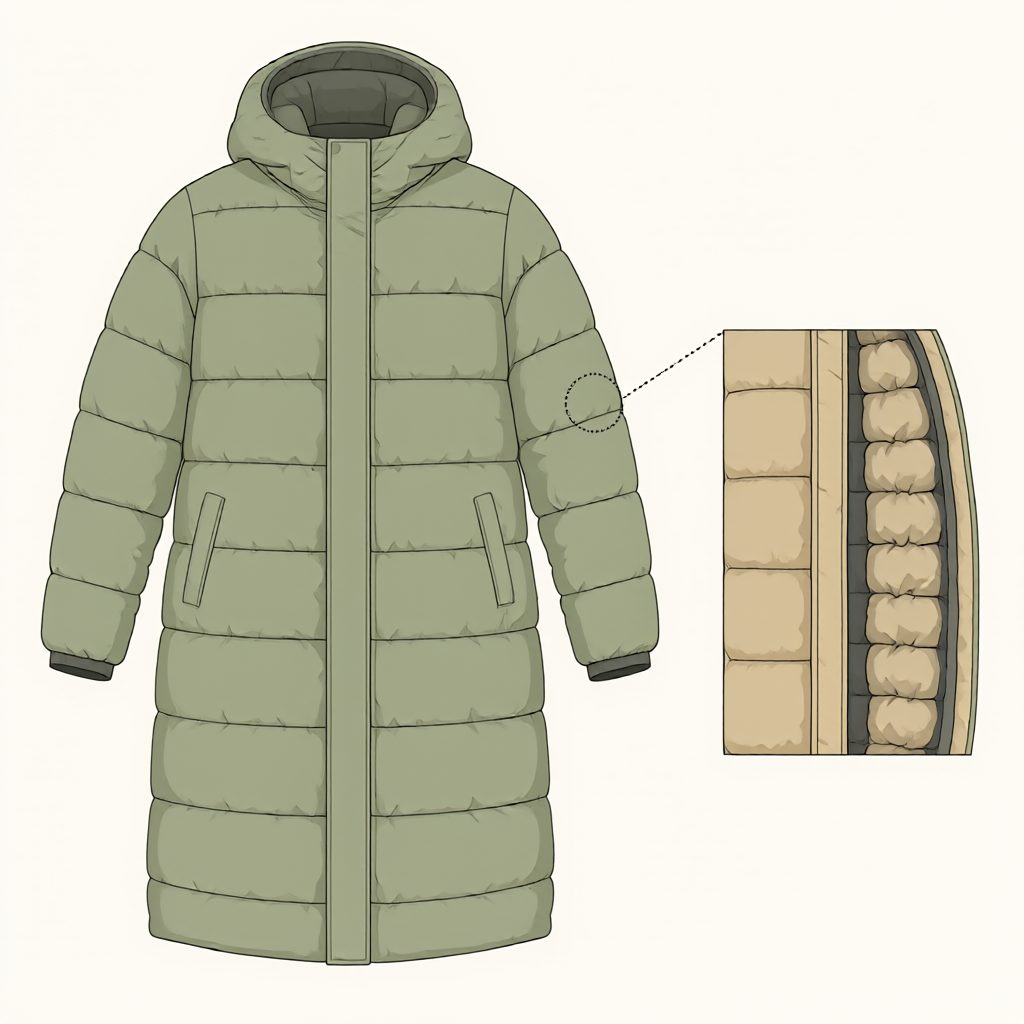
A plus size winter down jacket fails when it traps heat poorly due to compressed fill or shallow chambers, or restricts movement from narrow armholes. Chest circumference alone won't reveal this. Evaluate fill weight, fill power, baffle type, and armhole room against actual construction, not labeled size.
Fill Weight: What the Label Actually Tells You
Fill weight is the total down mass in grams. For plus size bodies, the larger torso surface area means the same fill weight spreads thinner; a 200 g fill in size M becomes a 160 g equivalent in 2XL. Plus size wearers need higher fill weights: for 0°C to -10°C, a slim fit requires roughly 180 to 220 g, while standard needs only 140 to 170 g. Longer hemlines add area requiring more down; if fixed, the insulation layer thins. Divide fill weight by covered torso area. For cold-weather, plus size jackets need at least 0.8 g per 100 square centimeters; below that, it's only a transitional piece.
Fill Power: The Number That Changes Everything
Fill power measures the volume a down mass occupies when lofted. European ratings (mm) and US ratings (cubic inches per ounce) differ slightly; focus on the US scale. Ratings below 500 compress easily under larger bodies; 500 to 600 is adequate for mild winter; 600 to 700 is good for cold; 700 to 800 gives the highest warmth-to-weight ratio; above 800 is specialist-grade. Fill power matters more for plus size wearers because a larger frame creates more pressure points. High fill power resists compression, retaining thickness where the body exerts force. The practical threshold is 650 or higher for below-freezing use; below 650, down compresses at elbows and shoulders during activity.
Baffle Type: How the Down Is Contained
Baffle construction determines how fill power translates to warmth. Sewn-through stitching creates flat chambers with cold spots at seams and restricted loft height, making it poor for plus size winter use. Box baffles use fabric walls to create 3D chambers, allowing full expansion and eliminating cold lines—crucial for front and back panels where larger torsos create greater temperature gradients. Press the surface: box baffles feel puffy, sewn-through feels flat at seams. Bonded construction removes needle holes and sheds weather better, but is less durable under flexing; plus size wearers who move frequently should prioritize box baffles for longevity.
Armhole Room: The Most Overlooked Fit Dimension
Armhole circumference is rarely listed but determines arm freedom, layering, and overhead reach. An insufficient armhole pulls shoulders and restricts forward movement, causing upper back tension. For plus sizes, the armhole should measure 5 to 7 cm larger than the actual arm circumference over the base layer. Too small an armhole pulls the sleeve centerward, riding up the underarm seam and creating a wrist gap; a larger armhole keeps the cuff aligned. Test by putting on the jacket over a medium-weight base layer and raising arms to shoulder height—the hem shouldn't lift, and no tension lines should appear. A dropped shoulder seam can increase effective armhole room without altering chest measurement.
Checking the Full Package: A Verification Sequence
First, check fill weight: divide stated grams by torso area, aiming for at least 0.8 g per 100 square centimeters (increase for longer jackets). Second, check fill power: look for a minimum 650 cubic inches per ounce for below-freezing use. Third, check baffle type: press chest and back panels; choose box baffles over sewn-through for cold conditions. Fourth, check armhole room: wear over a base layer, raise arms to shoulder height; if the hem lifts or upper back tightens, it's too small. Fifth, check closures: adjustable cuffs and a hem drawcord prevent the bellows effect where movement pumps out warm air. These five checks identify a jacket that works for a larger body, not just one that fits the chest.