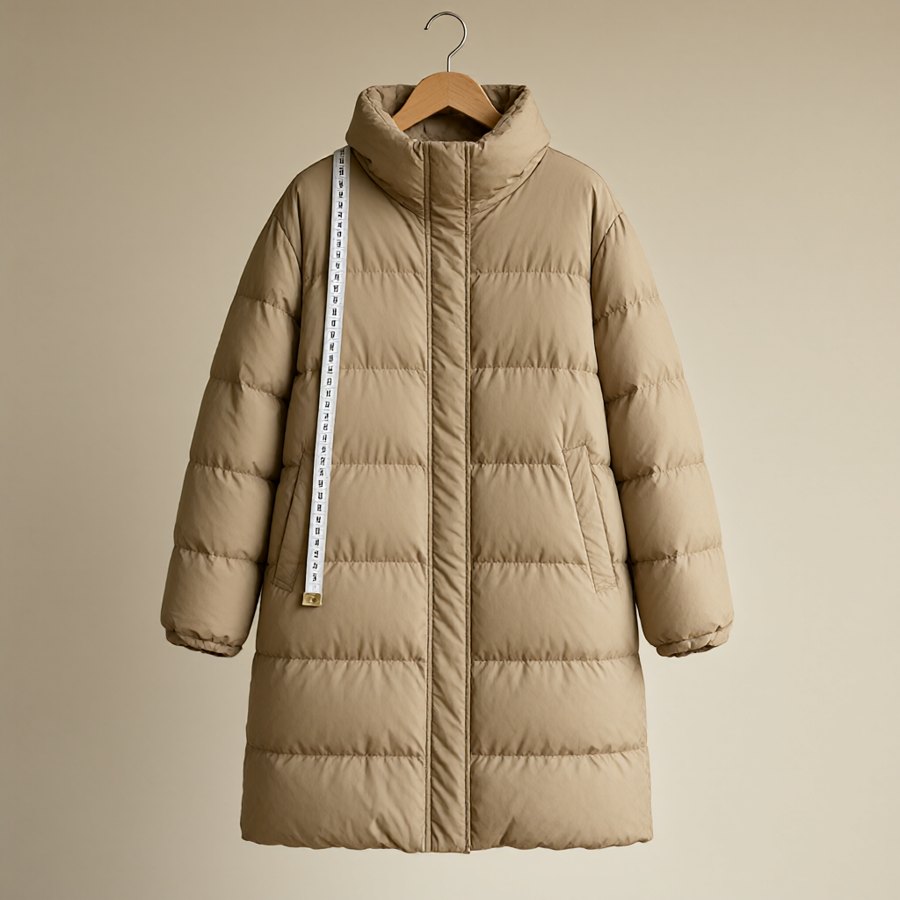
Choosing a plus size winter coat requires more than checking the size label. Standard sizing scales width but ignores where plus size bodies differ. Common failure points are the bicep, armhole, and cross-back width. A coat that fits the waist can still restrict upper arms, pull at shoulders, or lack room for layers. The goal is accommodating winter layers without excessive volume that drops shoulders or lengthens sleeves.
Understanding Down Fill Weight
Down fill weight is the actual mass of down inside the garment, measured in grams, distinct from fill power (loft). For plus size coats, fill weight matters because the garment covers a larger surface area; a fill weight working for a smaller body provides less insulation per square inch on a larger frame. Check the declared fill weight on the care label, where down type, down cluster percentage, and fill weight must be stated.
Under the national standard, the declared down cluster percentage must be no lower than 50 percent, and fill weight deviation is allowed to be no more than minus 5.0 percent. Thus, a coat labeled 300 grams could contain as little as 285 grams. When comparing coats, look for a higher declared fill weight for the same warmth rating.
Baffle construction also affects performance. Sewn-through baffles create cold spots at stitch lines by compressing down. Box baffles have internal fabric walls, allowing down to loft fully and reducing cold spots. For plus size bodies, cold spots are more noticeable at sides and under arms where the coat stretches; box baffles are preferable for consistent warmth across a larger surface area.
Armhole Depth and Bicep Room
The armhole (armscye) is where the sleeve attaches. A shallow armhole pulls the shoulder seam toward the neck, restricts reach, and prevents lifting arms fully without the coat riding up or pulling at the chest. The shoulder seam should sit at the shoulder edge, not slide down the arm.
The bicep is the single most common failure point. Measure the upper arm relaxed and flexed, then compare with sleeve circumference. Allow at least one to two inches of ease over a long-sleeve top. Check sleeve circumference with the thickest layer, not a thin base. A tight bicep restricts blood flow and movement.
Armhole depth should be evaluated relative to the bust, as a full bust pushes the armhole forward. The cross-back width must clear both a broad back and a full bust; if the coat fits the front but pulls at the back, shoulder movement is restricted. A two-way zip helps by opening the lower coat independently, reducing strain when seated.
Layering Room and Fit Checks
Layering room is the space between coat and body measured over actual cold-weather layers. Try the coat over the full layering system. Fasten it fully, reach forward—the back shouldn't pull, armholes shouldn't dig, front shouldn't strain. Lift arms to shoulder height; sleeves shouldn't bind at the bicep. Sit and walk to check if it rides up or pulls at hips.
Seek ease in the right places rather than automatically sizing up, which adds volume everywhere, dropping shoulders and lengthening sleeves. Sleeve length should still cover the wrist for gloves. Excess waist/hip volume can be adjusted with a drawstring or belt, but excess sleeve length cannot. A tailored shoulder with a wider body fits better than a coat simply larger in every dimension.
The front fastening should close without strain at bust and hips; if the zipper pulls apart or buttons gap, it's too tight. A two-way zip makes seated wear easier by opening the bottom for legroom. The collar should close without gaping or pressing the throat. A stand collar or hood with drawstring adjusts neck fit and prevents drafts.
Fabric and Construction Details
The shell should be wind- and water-resistant; the lining must be breathable (non-breathable films are prohibited as linings under the down garment standard). The shell, lining, and interlining quilted with down must resist leakage—check by running a hand over fabric for poking feathers. Loose threads, uneven stitching, and sharp edges are defects.
The zipper should mesh smoothly without burrs or catching; test fully fastened and with two-way zip partially open. Pockets should sit where hands naturally rest. For plus size bodies, pockets too far forward are uncomfortable when seated because the coat bunches at the hip.
Checking the Fit Over a Full Layering System
Always test with the complete layering system for the coldest conditions. Base, mid, and fleece layers add inches of circumference; the coat must accommodate them without compressing the down, which loses loft and insulating value if squeezed. The armhole should allow full range of motion without the shoulder seam slipping. Check cross-back measurement by reaching across the chest—the back panel shouldn't pull. The coat shouldn't gap at the front when arms are lifted, nor ride up at the wrist when arms extend forward.
Length affects warmth; longer coats cover hips and thighs, reducing lower body heat loss. For plus size bodies, the hip is often the widest point, so the hem must close comfortably. A coat too tight at the hips rides up when seated. A longer coat with side vents or two-way zip accommodates sitting without pulling.
Evaluating Down Quality and Content
Down cluster percentage indicates insulation quality—higher percentages mean better loft and warmth. The label must state down type, cluster percentage, and fill weight. Higher cluster and fill weights generally provide more warmth per unit of weight. Given the minus 5.0 percent deviation allowance, a coat with a declared 350 grams could contain 332.5 grams and still comply.
Check shell and lining for down leakage at seams and stitch lines; sewn-through construction allows escape through needle holes. Tightly woven shells reduce leakage but may feel stiff. Soft, brushed linings improve comfort but shouldn't be so thick they reduce internal volume. Judge internal space with layers worn, not with the coat empty.
Final Fit Checklist
Before purchasing, run through these checks with the coat fully fastened over the intended layering system:
Measure upper arm relaxed and flexed; compare to sleeve circumference and allow one to two inches of ease over the thickest layer. Shoulder seam should sit at the shoulder edge. Reach forward—the back shouldn't pull. Lift arms—armholes shouldn't dig in. Sit—front fastening shouldn't strain, hem shouldn't ride up at hips. Walk—sleeves should still cover the wrist with gloves. Zipper should mesh smoothly without catching. Check for down leakage at seams. Verify label states down type, cluster percentage, and fill weight.