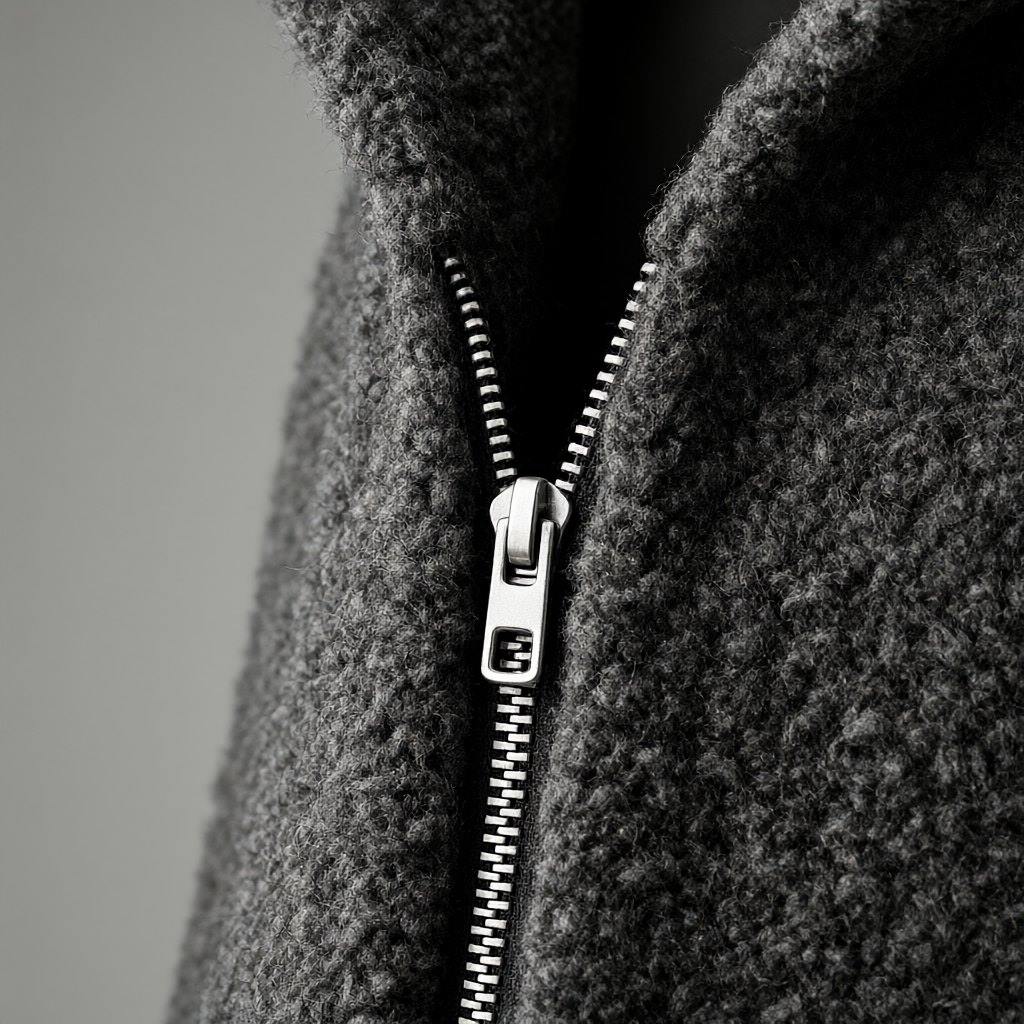
Evaluating plus size winter coat fasteners requires analyzing mechanical stresses that exceed standard garment parameters. Larger body circumferences generate higher crosswise tension on closures and seams, making standard fastener specifications inadequate. Structural integrity depends on quantifiable metrics: zipper chain crosswise strength, slider pull-off resistance, seam slippage under load, and armhole stress distribution. These factors determine whether a coat maintains closure security and seam continuity during regular wear and movement.
Two-Way Zipper Chain Strength Parameters
Two-way zippers on plus size coats allow lower hem opening for mobility while maintaining upper body enclosure. The primary structural requirement is crosswise chain strength, measured per ASTM D2061. This test clamps the zipper chain 25.4 mm apart and applies tension at a rate of 305 mm plus or minus 10 mm per minute until failure. For plus size garments, the crosswise chain strength must exceed the combined expansion forces exerted across the torso and hips when seated.
ASTM D2061 comprises ten test methods covering chain elements, stops, separable units, sliders, and slider pulls. Six methods are tension pulls on a testing frame, one is a slider compression test, one measures deflection and recovery, and two are twisting tests. No single test determines end-use suitability; the tests are inter-related, requiring multiple evaluations for commercial acceptance. Crosswise chain strength remains the baseline metric for assessing whether a zipper will separate under circumferential load.
Teeth pull-off loads a single element until it separates from the tape, indicating individual element retention strength. Stop holding strength evaluates top stop, bottom stop longitudinal, bottom stop crosswise, and stringer separation resistance. Separable unit tests cover pin pull-off, fixed retainer, and crosswise separation. Plus size coats require separable units with higher longitudinal retention to prevent bottom stop failure when the hem is stressed during sitting.
Slider Pull-Off Strength and Angular Resistance
Slider failure is a common functional breakdown on plus size coats, occurring when the slider body detaches from the chain under asymmetric load. ASTM D2061 measures resistance to pull-off of the slider pull by applying load through the pull at right angles to the top plane of the slider. This perpendicular force simulates the upward yank on a zipper tab when the coat is tight across the torso. Slider pulls on plus size coats must withstand perpendicular forces matching the garment's circumferential tension without unthreading from the chain.
Resistance to angular pull-off applies load at 135 degrees to the slider top plane. This angled force replicates diagonal stress encountered when the wearer reaches forward or across the body, pulling the zipper tab sideways. Plus size coats experience amplified angular forces due to broader back and chest dimensions. A slider that passes perpendicular pull-off tests but fails angular pull-off tests will detach during routine arm movements. Both perpendicular and angular pull-off values must meet specification thresholds for the fastener to remain functional.
The slider deflection and recovery test assesses permanent deformation of the slider body under load. If the slider channel widens beyond recovery, it will skip teeth or separate from the chain. For plus size applications, slider bodies require thicker walls and tighter channel tolerances to resist deflection under the higher crosswise forces inherent to larger circumferences. Compression testing on the slider further verifies that the body will not crush or distort when subjected to external pressure against the garment.
Seam Slippage Under Load Per ASTM D1683 and D434
Seam slippage occurs when yarns in woven fabrics shift along the stitch line, creating a gap that compromises thermal insulation and structural integrity. ASTM D1683 measures sewn seam strength in woven fabrics by applying force perpendicular to the sewn seams. This identifies the maximum breaking force to rupture a sewn seam and calculates seam efficiency. For plus size coats, seam efficiency must account for the increased perpendicular forces exerted across side seams and center back seams when the garment is stretched over larger curvatures.
ASTM D1683 identifies the seam strength threshold at which stitching fails without fabric damage, allowing repair, and the force at which seam strength results in yarn slippage and displacement. Seam slippage exceeding customer specification values severely reduces garment integrity, rendering the product unusable. Plus size coat specifications must set lower slippage thresholds than standard sizes because the same absolute slippage distance represents a proportionally larger gap relative to the required fabric coverage.
ASTM D434 evaluates resistance to yarn slippage using a standard seam, with equivalent procedures in ISO 13935-1 and GB/T 13773.1-2021 using the strip method. Specimens are 25 mm by 200 mm strips with a standard seam sewn at the center at approximately 12 stitches per 25 mm. At least five specimens per group are conditioned at 20 plus or minus 2 degrees Celsius and 65 plus or minus 4 percent relative humidity for 24 hours. Loading occurs at a constant rate of 100 mm per minute until seam rupture or a set slippage threshold is reached. Plus size coats require stitch densities at or above 12 stitches per 25 mm to maximize inter-yarn friction and prevent slippage under sustained cross-body tension.
Armhole Stress Checks and Seam Integrity
Armholes on plus size coats experience concentrated stress vectors where the sleeve joins the body. When the arm is raised or extended forward, the armhole seam undergoes combined shear and tension forces. If the armhole circumference lacks sufficient ease, the seam experiences load spikes that exceed the seam efficiency identified by ASTM D1683. Armhole depth must provide enough range for shoulder flexion without transferring tensile load to the stitch line.
Stress checks at the armhole involve evaluating the intersection of the sleeve seam, side body seam, and shoulder seam. This junction handles the highest localized force during reach movements. Seam slippage at this point creates permanent gaps that cannot be repaired without restructuring the garment. Reinforcement bar tacks or overlap stitching at the armhole junction increases the local stitch density, raising the force required to initiate yarn displacement per ASTM D434 parameters.
The armhole must also accommodate layering without increasing seam stress. When thick mid-layers are worn underneath, the armhole circumference expands, placing continuous static load on the armhole seam. This static load must remain below the seam rupture threshold identified in ASTM D1683 testing. Coats designed for plus size fits must specify armhole ease that accounts for both dynamic movement forces and static layering expansion without relying on fabric stretch to absorb the load.
Verification Checklist for Coat Fasteners and Seams
Confirm the two-way zipper crosswise chain strength rating meets or exceeds the maximum anticipated circumferential tension, validated at the 305 mm per minute test rate.
Verify slider pull-off strength values for both perpendicular and 135-degree angular pulls, ensuring they accommodate asymmetric loading from back and chest dimensions.
Check seam slippage thresholds against ASTM D434 and ASTM D1683 specifications, confirming stitch density is at least 12 stitches per 25 mm at all structural seams.
Assess armhole seam reinforcement, verifying bar tacks or overlap stitching at the sleeve-body junction to prevent localized yarn displacement.
Ensure armhole ease accounts for static layering expansion without exceeding the static load seam rupture threshold.