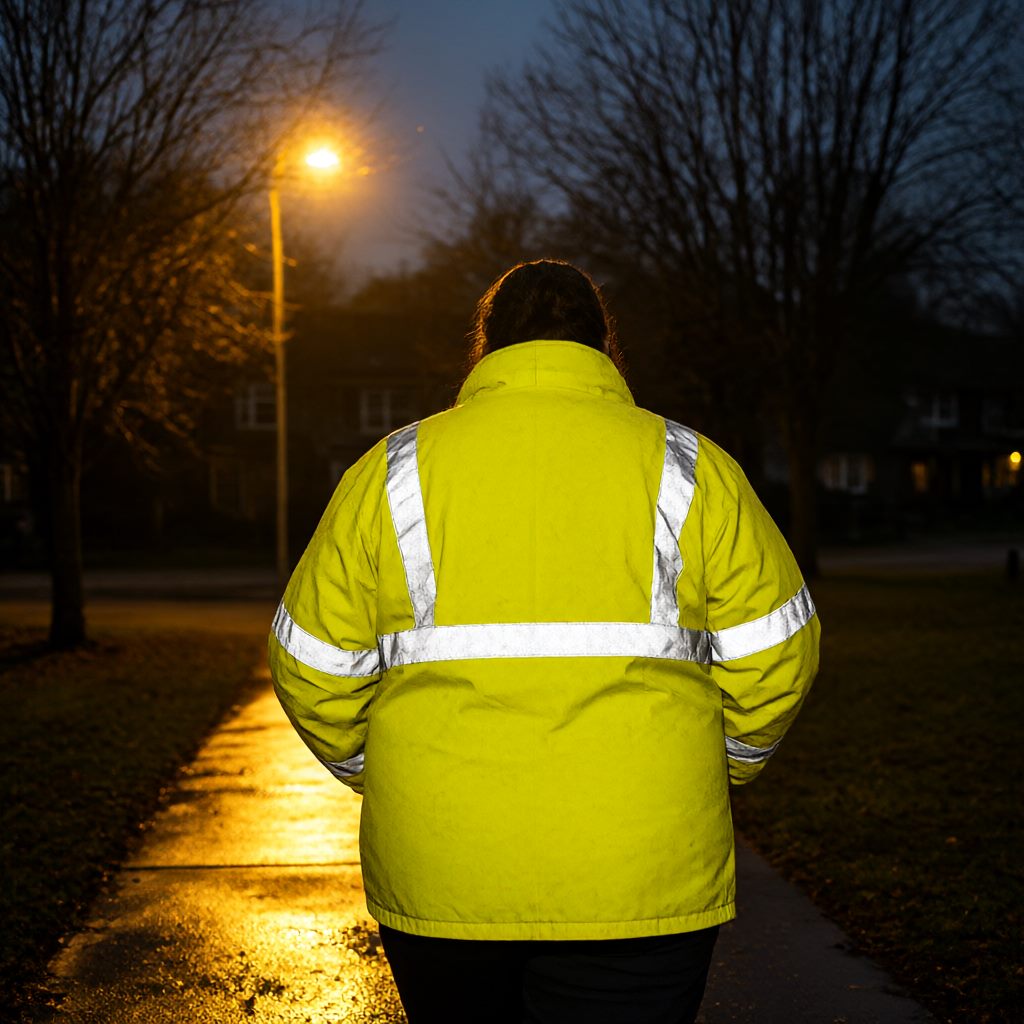
Choosing plus size reflective outerwear for winter walking demands verifying three measurable parameters: the EN ISO 20471 class rating, the minimum area of fluorescent and retroreflective material, and the garment fit over mid-layers. A plus size jacket must retain its certified visible area even when worn open or stretched over a thick jumper. If the outerwear fails to maintain tape geometry or loses background material area due to poor fit over layers, the effective visibility class drops, reducing safety in low-light conditions.
EN ISO 20471 Class Requirements and Material Areas
EN ISO 20471 defines three classes of high-visibility garments based on the minimum area of visible material. Class 1 requires 0.14 m2 of background fluorescent material and 0.10 m2 of retroreflective material. Class 2 requires 0.50 m2 of background material and 0.13 m2 of retroreflective material. Class 3 requires 0.80 m2 of background material and 0.20 m2 of retroreflective material. Combined performance material applies only to Class 3, requiring 0.20 m2. For winter walking in traffic or near vehicles, Class 3 provides the necessary visibility level.
Class 2 is typical of sleeveless vests and does not offer sufficient area for high-risk walking environments. Class 3 requires sleeves with retroreflective bands or full-length trouser legs with bands. The three approved background colours are yellow, orange-red, and red. A plus size garment must meet these same area thresholds; sizing up does not alter the minimum material requirements, though it does demand more fabric to achieve the required area across a broader body circumference.
Garments can be certified as an ensemble, but the combined class must be stated in the manufacturer user information. Two separate Class 2 labels cannot simply be added together to equal Class 3. An open jacket loses visible area, and layers worn over the top can cover the tape, altering the certified class. Always check the label for the stated class of the specific garment, not the sum of individual pieces.
Retroreflective Tape Geometry and Placement
EN ISO 20471 sets measurable geometric requirements for retroreflective tape placement. At least one retroreflective band must encircle the torso, with a maximum tilt of plus or minus 20 degrees from the horizontal. Two bands must run from the front to the back over the left and right shoulders. The bottom edge of the lowest torso band must sit at least 50 mm above the garment hem. Multiple horizontal retroreflective bands must have a minimum spacing of 50 mm between them.
Tape width requirements scale with class. Class 1 requires a minimum tape width of 25 mm. Class 2 and Class 3 require a minimum tape width of 50 mm. The fluorescent and retroreflective materials must be uniformly distributed across the front and back of the garment, with the difference in area between the two sides not exceeding 10 percent. The domestic standard GB 20653 shares these identical area thresholds and geometric constraints.
For plus size outerwear, tape placement must account for the broader torso. Bands that encircle the torso must lay flat and remain continuous without stretching gaps. If a jacket is worn open, the vertical overlap loss reduces the visible background and retroreflective area. Side visibility at junctions relies on tape circling the body and arms, not just sitting across the chest. Ensure shoulder bands sit correctly on the plus size shoulder slope without slipping off the edge.
Plus Size Fit Over Winter Layers
Fit determines whether a plus size high-visibility jacket maintains its rated class when worn over winter layers. A jacket that fits too tightly over a jumper stretches the retroreflective tape, potentially reducing its reflective effectiveness and altering the band spacing below the 50 mm minimum. Conversely, a jacket that flaps in the wind creates uncomfortable drag, and baggy cuffs can catch on machinery or obstruct hand movement.
Look for adjustable cuffs and hem draws to seal out cold air while managing the bulk of under-layers. The cut must allow arms to move freely without pulling the hem up and exposing the lower torso. A plus size winter walking jacket needs specific room for a jumper underneath without stretching the reflective bands. Pockets filled with items should not pull the front panels open, which would cover the vertical reflective tape and reduce the visible area below class minimums.
Tape must be stitched flat with no bubbling or peeling. When the plus size garment is stretched across the chest or belly, the tape must continue to function and maintain its required width. Verify that the front zipper closure allows the jacket to sit flat; a jacket that pulls open at the center front loses background area and disrupts the torso encircling band. The hem must drop low enough to cover mid-layers without the underlying jumper pushing the jacket hem up past the 50 mm tape boundary rule.
Checking Plus Size Reflective Outerwear Before Purchase
Measuring a plus size reflective jacket requires checking the tape layout against the body dimensions when layered. Put on the thickest intended mid-layer and pull the outerwear on over it. Zip the front fully and verify that the fabric does not pull across the chest or stomach. If the fabric stretches, inspect the retroreflective tape to confirm it has not warped or separated from the background material. Unzip the jacket and observe how much visible area is lost; if the open front exposes the inner layer and hides the vertical torso bands, the fit is too tight for safe walking without full closure.
Check the sleeve length and cuff adjustment. The sleeve must contain retroreflective bands to count toward Class 3 certification. When reaching forward or bending the arms, the sleeve should not ride up past the wrist, and the cuff closure must fit over or under gloves without leaving a gap. Inspect the shoulder bands to ensure they span from the chest to the back across the top of the shoulder, not sliding down the upper arm.
Examine the hem length. The lowest retroreflective band must remain at least 50 mm above the hem edge. When walking, the jacket hem should not rise high enough to expose the mid-layer or move the reflective band closer than the 50 mm limit to the bottom edge. Verify the tape spacing on the torso; adjacent horizontal bands must maintain the 50 mm gap even when the wearer is seated or bending, which shifts the fabric layout on a plus size torso.
Executable Verification Checklist
1. Confirm the label states Class 3 with 0.80 m2 background and 0.20 m2 retroreflective material.
2. Verify tape width is 50 mm for Class 2 or 3 garments.
3. Check that one horizontal band encircles the torso with a tilt under 20 degrees.
4. Ensure the lowest torso band sits 50 mm or more above the hem.
5. Measure adjacent horizontal tape spacing at 50 mm or greater.
6. Put on the thickest winter mid-layer and confirm the jacket zips without stretching the tape.
7. Verify shoulder bands run front to back without slipping off the shoulder edge.
8. Adjust cuffs and hem to confirm closures secure over layers without pulling the front open.
9. Inspect tape stitching for flat placement with no bubbling or peeling.
10. Confirm fluorescent and retroreflective material distribution between front and back differs by less than 10 percent.