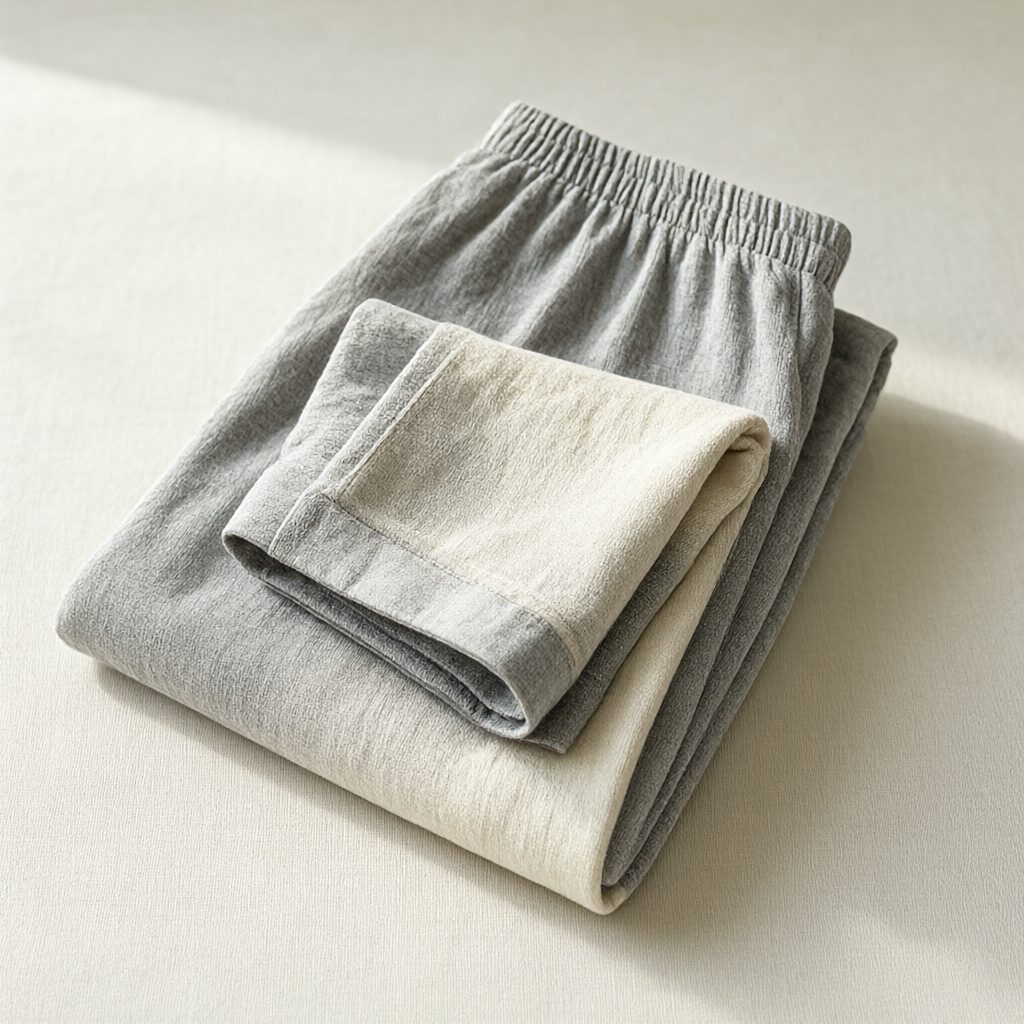
Plus size pajama and lounge set fit requires evaluating four technical parameters: waistband pressure, sleeve and inseam length, fabric weight per square meter, and flammability classification. Garments that fail on any of these metrics cause restricted circulation, improper proportioning, inadequate drape, or regulatory non-compliance. Selecting appropriate sleepwear involves measuring body dimensions, comparing them against garment specifications, and verifying federal flammability standards.
Waistband Pressure and Elastic Recovery
Waistband pressure determines whether a pajama bottom stays in place without restricting blood flow or creating skin indentations. The evaluation metric is the stretch ratio. Measure the waistband at rest, then stretch it to its maximum extent. A waistband must achieve a stretched circumference at least double the wearer's waist measurement to distribute pressure evenly. If the stretched measurement is less than two times the waist circumference, the band will exert excessive localized pressure.
Elastic recovery affects long-term fit. Stretch a one-inch section of the waistband to five inches and release it. Measure the same section immediately. If the length exceeds one and one-eighth inches, the elastic lacks sufficient recovery and will permanently relax after several wash cycles. Encased elastic constructions distribute pressure over a wider area than exposed elastic bands, reducing pressure points on larger midsections.
Drawstrings supplement elastic waistbands but do not replace them. A drawstring channel must allow the cord to move freely across the entire waistband circumference. If the drawstring catches, it creates isolated pressure points. Tie the drawstring at the side seam rather than the center front to prevent the knot from pressing into the abdomen when sitting or reclining.
Sleeve and Inseam Length Proportions
Sleeve and inseam lengths on plus size lounge sets frequently mismatch torso proportions because manufacturers scale widths without adjusting lengths. Measure sleeve length from the shoulder seam to the wrist bone. On a long-sleeve top, the sleeve cuff should reach the wrist without riding up when the arm is extended forward. If the cuff sits higher than two inches above the wrist bone, the sleeve is short for the torso proportion.
Inseam measurement dictates lounge pant length. Measure from the crotch seam to the desired hemline, typically the ankle bone for full-length pants. Plus size bodies often carry weight in the lower abdomen and inner thighs, which shortens the effective inseam. Add one and a half inches to the standard inseam measurement to account for fabric take-up across a fuller thigh. Without this addition, the pant hem will ride up above the ankle when seated.
Arm and leg circumference affects length fit. A sleeve with a narrow bicep circumference pulls the fabric upward, shortening the effective sleeve length. Verify the bicep circumference of the sleeve matches the wearer's upper arm measurement plus two inches for ease. The same principle applies to the thigh circumference on lounge pants. Insufficient thigh width causes the inseam to ride up during movement.
Fabric Weight per Square Meter and Drape
Fabric weight per square meter (g/m²) determines the drape, opacity, and mechanical stretch of pajama and lounge sets. Lightweight knit fabrics for sleepwear range from 150 to 220 g/m². Fabrics below 150 g/m² lack sufficient opacity for lounge wear and stretch out over the day. Fabrics above 220 g/m² add thermal retention that may cause overheating during sleep.
Fabric weight correlates with surface stability. Brushed or raised surface fabrics, such as fleece, pill and migrate fibers when the weight drops below 200 g/m². Plain surface fabrics, like single jersey knits, maintain structural integrity at lower weights, but require a minimum of 180 g/m² to prevent camisole straps from digging into the shoulders under the weight of the garment.
Calculate fabric weight using a swatch. Cut a 10 cm by 10 cm square, weigh it in grams, and multiply by 100. This yields the g/m² value. Compare this value against the product specification. A variance greater than ten percent indicates inconsistent manufacturing, which leads to unpredictable shrinkage rates after laundering.
Sleepwear Flammability Checks and 16 CFR Part 1610
All adult wearing apparel, including pajamas, robes, and loungewear, must comply with 16 CFR Part 1610, the general wearing apparel flammability standard. This standard classifies fabrics into three classes based on burning speed. A standardized flame is applied at a 45-degree angle to a 5.08 cm by 15.24 cm specimen, and the time to travel a set distance is measured. Testing requires five specimens, tested before and after dry cleaning.
Class 1 textiles exhibit normal flammability. For plain surface fabrics, the flame spread time is 3.5 seconds or more. For raised surface fabrics, the flame spread time exceeds 7 seconds, or the fabric exhibits a surface flash between 0 and 7 seconds without igniting the base fabric. Class 1 textiles are acceptable for adult pajamas and loungewear.
Class 3 textiles exhibit rapid and intense burning. Plain surface fabrics with a flame spread time under 3.5 seconds and raised surface fabrics with a flame spread time under 4 seconds that ignite or melt the base fabric fall into Class 3. Class 3 textiles are prohibited for use in wearing apparel. Class 2 textiles exhibit intermediate flammability for raised surface fabrics, with flame spread times between 4 and 7 seconds and base fabric ignition.
Flammability behavior depends on fiber type, fabric weight, surface finish, and construction, rather than fabric softness. Certain fabrics receive testing exemptions under 16 CFR 1610.1(d). Plain surface fabrics weighing 2.6 oz/yd² (88.16 g/m²) or more are exempt from testing regardless of fiber content. Plain or raised surface fabrics made entirely of acrylic, modacrylic, nylon, olefin, polyester, or wool are also generally exempt from testing.
Verifying Compliance and Garment Specifications
Product listings must state flammability compliance. Adult sleepwear falls under 16 CFR Part 1610. Children's sleepwear sizes 0 through 6X and 7 through 14 falls under 16 CFR Parts 1615 and 1616, which require a vertical flame test, self-extinction, limited char length, and mandatory third-party testing. Verify the correct standard applies to the garment size.
For fabrics not exempt by weight or fiber content, request the 16 CFR Part 1610 test report from the supplier. The report must confirm the fabric achieves Class 1 classification. Garments constructed from multiple fabric types require each component to meet the standard independently. A lounge set combining a cotton top and a nylon bottom must have documentation for both materials.
Exempt fabrics still require verification of the exemption criteria. If a manufacturer claims an exemption based on a fabric weight of 88.16 g/m² or more, weigh a sample of the fabric. If the actual weight falls below 88.16 g/m², the plain surface fabric exemption does not apply, and the fabric requires formal flammability testing to ensure it does not fall into Class 3.
Fit and Compliance Checklist for Plus Size Pajama and Lounge Sets
Measure the waistband at rest and at full stretch; the stretched circumference must equal or exceed double the wearer's waist measurement. Test elastic recovery by stretching a one-inch section to five inches; upon release, it must measure no more than one and one-eighth inches. Measure sleeve length from shoulder seam to wrist, ensuring the cuff reaches the wrist bone. Add one and a half inches to the inseam measurement to compensate for fabric take-up across fuller thighs. Verify bicep and thigh circumferences include two inches of ease. Confirm fabric weight is between 150 and 220 g/m² for sleepwear, weighing a 10 cm by 10 cm swatch and multiplying by 100. Verify 16 CFR Part 1610 compliance; ensure the fabric is Class 1 or meets the 88.16 g/m² plain surface exemption. Confirm fiber content exemptions apply, or request formal flammability test documentation for non-exempt materials.