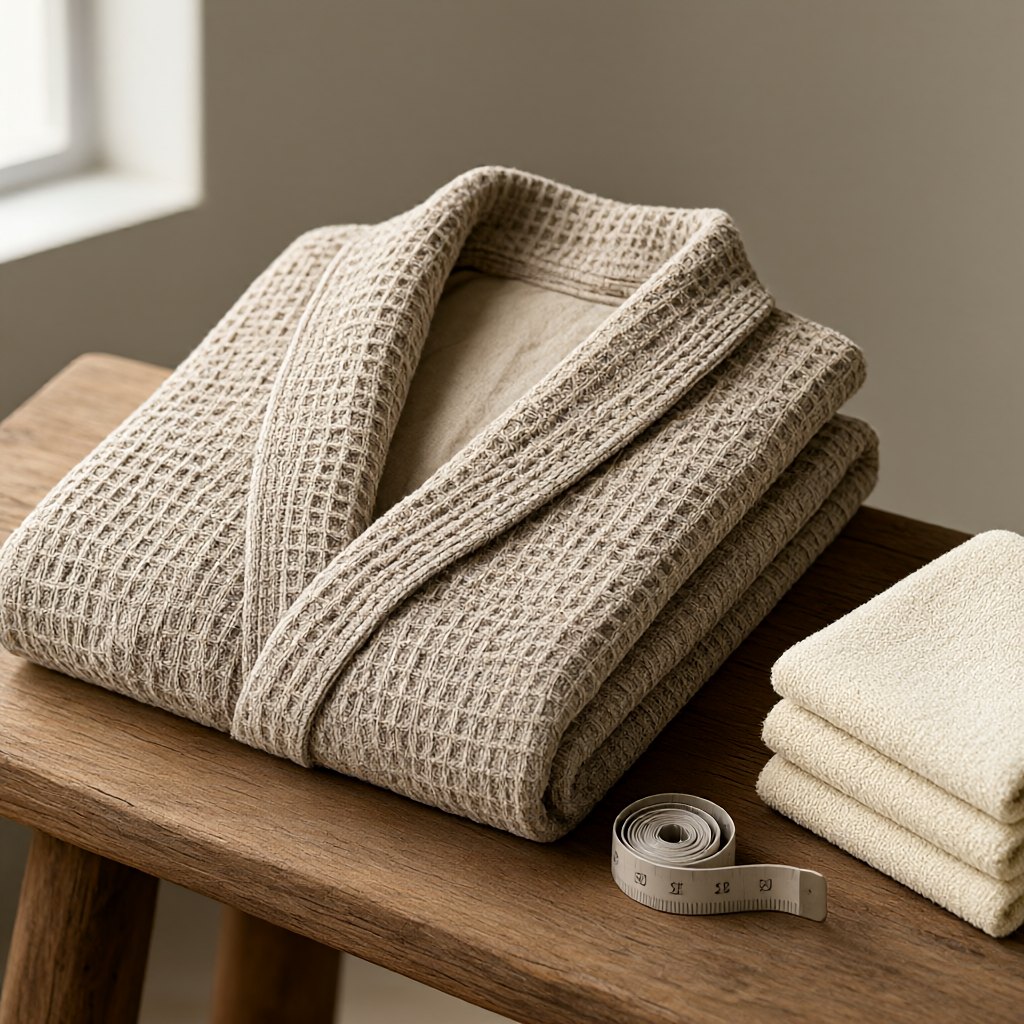
A bathrobe that fits a larger body must provide full overlap across the chest, unrestricted arm movement, and a belt long enough to tie without strain. Standard sizing labels fail to convey the structural dimensions needed for adequate coverage. Evaluating a bathrobe requires measuring the back panel width, sleeve opening circumference, and belt length before purchase.
Back Panel Width and Chest Overlap
The primary fit failure in bathrobes for larger bodies is insufficient width across the back and front panels. When the front panels meet at the center without at least six inches of overlap on each side, the robe gaps during movement. Measure the back panel from side seam to side seam while the robe lies flat. A measurement under 30 inches indicates the robe will lack overlap for a 50-inch chest.
Shawl collars and kimono cuts handle larger proportions differently. A shawl collar adds structured width across the upper chest but requires the back panel to match the shoulder span. Kimono cuts lack a defined shoulder seam, relying on the fabric width to drape. For shoulder spans exceeding 22 inches, kimono-cut robes provide better range of motion if the flat back measurement exceeds 32 inches.
Check the front overlap by wrapping the robe and marking where the opposing edge falls. The edge must cross the center line of the torso and extend past it by a minimum of four inches. If the belt loop placement sits closer to the side seam than the center front, the robe lacks the necessary width for a secure closure.
Sleeve Circumference and Armhole Depth
Sleeve fit dictates mobility. Measure the sleeve circumference at the bicep area, not the wrist. A sleeve bicep circumference under 18 inches restricts movement and causes the seams to pull. The sleeve must maintain a minimum of two inches of ease around the largest part of the arm when bent at the elbow.
Armhole depth affects how the sleeve hangs. Deep armholes exceeding 12 inches from shoulder point to armpit seam allow the sleeve to move with the arm. Shallow armholes pull the entire robe upward when the arms are raised, exposing the midsection and displacing the belt. To test this on a flat garment, measure from the top of the shoulder seam straight down to the underarm seam.
Sleeve length requires adjustment based on the robe's overall length. On a full-length robe, sleeves ending at the wrist bone get caught on surfaces during tasks. A sleeve length ending two inches above the wrist bone prevents fabric interference while maintaining arm coverage. On a knee-length robe, wrist-length sleeves maintain proportional balance.
Belt Length and Loop Security
The belt is the structural anchor of the bathrobe. A belt must wrap around the torso, cross at the center, and provide enough length to tie a knot without pulling the robe edges apart. Measure the belt end-to-end. For a 50-inch waist, the belt must measure at least 120 inches. This allows 50 inches to wrap the body, leaving 35 inches on each side to form a knot without tension.
Belt loops on larger robes require specific placement and reinforcement. Loops positioned too close to the side seams fail to hold the front panels in place. The primary loops must sit on the front panels, no further than four inches from the center edge. Loops sewn only into the outer fabric layer tear under stress; they must attach through the robe's inner lining or be stitched over a reinforced bar tack.
Self-tie belts constructed from the same fabric as the robe lack the rigidity to hold a knot tight against the body's movement. A belt with a woven structure or a subtle textural grip maintains knot tension. Avoid belts that are overly plush, as the bulk prevents a tight knot and adds protrusion at the waist.
Length Proportions and Hem Clearance
Bathrobe length determines both coverage and safety. A full-length robe must clear the floor by at least two inches when walking. Measure from the center back of the collar to the hem. Compare this to body height minus two inches. A robe hem that drags creates a tripping hazard and absorbs moisture from the floor, adding weight to the garment.
Mid-calf length offers a compromise between coverage and mobility. The hem should fall at the mid-point of the calf muscle, avoiding the back of the knee where fabric bunches during sitting. When seated, a full-length robe hem should not trap under the thighs. Knee-length robes provide the least restriction but require the front overlap to extend lower on the thigh to prevent exposure.
Shrinkage alters length after washing. Cotton and terrycloth robes shrink up to five percent in length. Purchase a robe with a hem length two inches longer than the target measurement to account for initial laundering. Wash and dry the robe once before hemming if alterations are required.
Fabric Weight and Drape Mechanics
Fabric weight affects how a robe drapes over a larger midsection. Heavyweight terrycloth exceeding 400 GSM hangs straight down, pulling the front panels open if the overlap is marginal. Lightweight waffle weaves under 200 GSM cling to the body's contours, maintaining closure but providing less insulation. A mid-weight fabric between 250 and 350 GSM offers a balance of drape and structural integrity to stay closed.
Drape mechanics determine whether the robe conforms to the body or tents outward. Fabrics with no stretch and a stiff hand do not fold smoothly at the waist when seated, creating pressure against the belt. A small percentage of elastane or a brushed interior finish softens the fabric's hand, allowing it to flex at the hip and waist without resisting the belt's tension.
Moisture absorption adds weight to the robe, altering its fit after a shower. A full-length terrycloth robe absorbs over a pound of water, pulling the shoulders down and stressing the belt loops. Shorter robes or those with hydrophobic synthetic blends shed water faster, maintaining their original fit and reducing strain on the closure points.
Fit Verification Checklist
Measure the flat back panel width and multiply by two; the result must exceed the chest measurement by at least six inches to ensure overlap. Measure the sleeve bicep circumference; it must provide two inches of ease over the arm measurement. Measure the belt end-to-end; it must exceed the waist measurement by at least 60 inches for a functional knot. Check the armhole depth; it must measure over 12 inches for unrestricted shoulder movement. Verify belt loop placement; loops must sit on the front panel within four inches of the edge. Confirm hem clearance; the robe must clear the floor by two inches in a standing position.