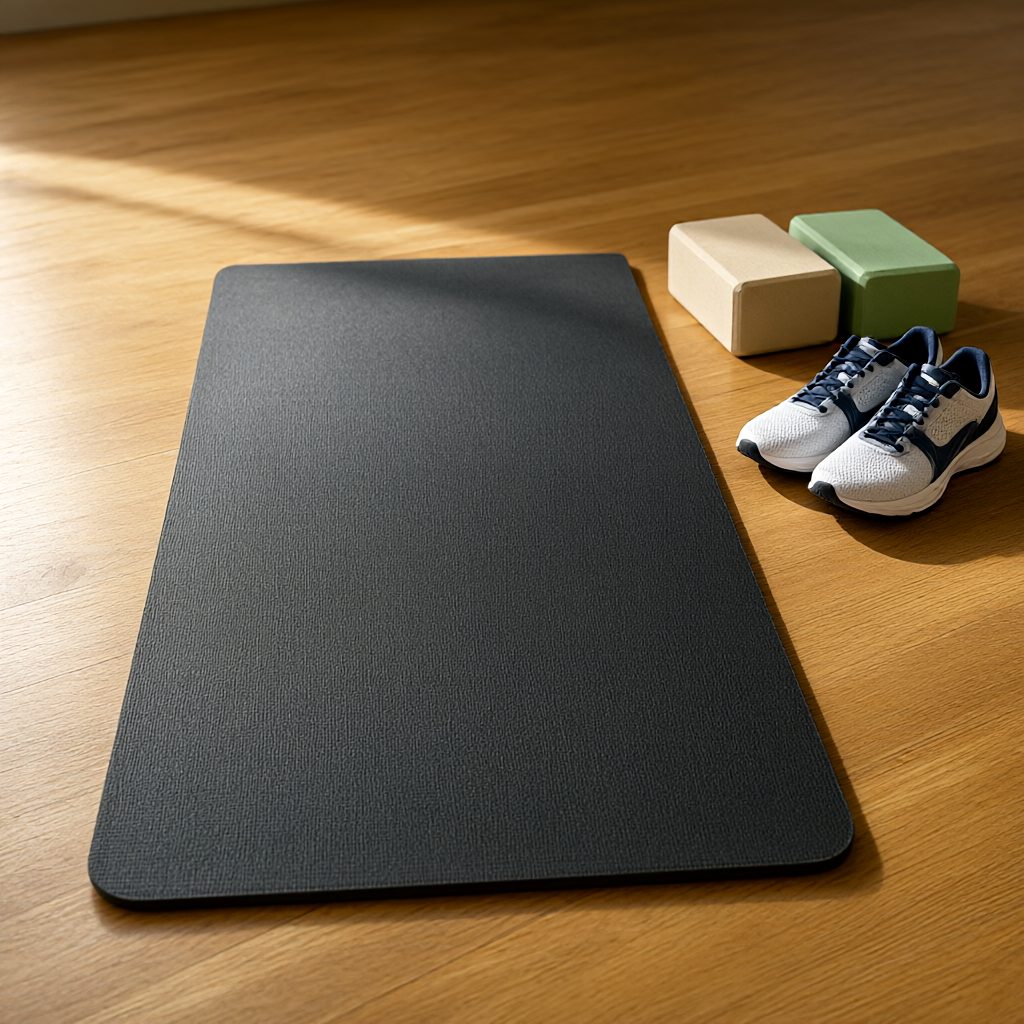
Choosing a home workout mat and blocks for a plus size body requires prioritizing density and material composition over pure thickness. A thick but low-density mat compresses fully under body weight, allowing the floor to be felt through the knees and wrists, which removes joint protection. A dense 6mm mat provides more support and better balance than a low-density 10mm mat that bottoms out. Proper selection relies on matching static friction coefficients, impact absorption rates, and dimensional tolerances to the practitioner's weight and movement demands.
Mat Thickness and Density Ratios for Joint Support
Standard mats range from 3.5 to 5mm in thickness, while thick mats measure 6mm and extra thick mats range from 7 to 10mm. According to GB/T 35448-2017, the allowable thickness deviation must be within ±0.50mm of the stated size. A mat measuring 6mm must not compress below 5.5mm under center load. For plus size practitioners, a thickness between 5 and 6mm with high density is preferable for active practices like vinyasa or power formats, as it prevents the feet from sinking and causing balance instability. Kneeling-heavy or restorative formats require 6 to 8mm of thickness paired with high density to prevent bottoming out when both knees and wrists bear weight simultaneously.
Field testing provides a clear pass or fail standard. Kneel on the mat with full body weight on one knee. If the hard floor surface can be felt through the mat, the material lacks sufficient density and will fail to absorb impact over time. If the feet sink deeply into the mat during standing poses and the stance wobbles, the mat is too plush and lacks the structural stability needed for balance. Impact absorption must rate at 20% or higher to meet safety thresholds for joint protection during floor work.
Friction Coefficients and Material Grip Ratings
Slip resistance is measured by the dry static friction coefficient, which dictates whether hands and feet maintain position during transitions. GB/T 3903.6-2020 sets material-specific minimums for this coefficient. TPU and natural rubber materials must achieve a dry static friction coefficient of 0.55 or higher. PVC and EVA materials have a lower threshold, requiring a coefficient of 0.45 or higher. For plus size practitioners generating higher downward force during movements, natural rubber or TPU materials at 0.55 or above provide the necessary anchor to prevent sliding during lateral weight shifts.
Long-term grip depends on wear resistance and compression rebound performance. Mats undergo repeated friction and compression cycles during regular use. Low-density foam mats lose their surface texture and flatten permanently, reducing the effective friction coefficient over time. High-density closed-cell mats maintain their surface structure, ensuring the friction coefficient remains consistent. Check the tensile strength, which must meet or exceed 0.5MPa, and the elongation at break, which must be at or above 40% for general mats and 200% for high-elasticity formulations, to confirm the material will not tear or permanently deform under heavy loads.
Dimensional Tolerances and Spatial Coverage
Standard mats measure 24 inches in width and 68 inches in length. Extra-wide options range from 26 to 30 inches, and extra-long options extend from 72 to 80 inches. Plus size practitioners with broader shoulders or taller stances require extended dimensions to keep hands and feet fully on the mat surface during wide grips or lunges. If a hand or foot lands on the bare floor during a transition, the break in grip compromises stability and joint alignment. An extra-wide mat measuring at least 30 inches prevents the hands from slipping off the edges during wide-arm poses.
Dimensional deviation limits ensure the mat provides the stated coverage. The allowable deviation for overall length and width is ±2.00mm. A mat labeled 80 inches long must measure between 2030.0mm and 2034.0mm. Smaller deviations indicate better manufacturing quality and prevent unexpected gaps in coverage. Multi-layer mats must maintain a peel strength of 20N or higher between layers to prevent delamination during repeated rolling and unrolling under heavier body weight.
Chemical Safety and Off-Gassing Thresholds
Materials in close skin contact during heated workouts must meet strict chemical limits. Formamide content must not exceed 200mg/kg. Total phthalate esters are limited to 0.1% by weight. Total volatile organic compound emission rates must remain at or below 0.500mg/(m²·h) to prevent respiratory irritation in enclosed home workout spaces. The odor rating must be at level 3 or lower on the standard scale. Mats exceeding these thresholds off-gas at higher rates when exposed to body heat and friction, degrading indoor air quality during sustained physical exertion.
Verifying these chemical metrics before purchase prevents long-term exposure issues. Request material safety data sheets that list formamide and phthalate concentrations. Avoid mats with strong chemical smells upon unboxing, as this indicates high TVOC levels and a likely failure to meet the 0.500mg/(m²·h) emission standard. Closed-cell TPU and natural rubber formulations typically meet these chemical limits more consistently than open-cell PVC or EVA options.
Block Load Capacity and Compression Resistance
Workout blocks elevate the floor to reduce the distance between the hands and the ground, decreasing strain on hamstrings and wrists. For plus size practitioners, blocks must support downward body weight without cracking or permanently compressing. High-density EVA foam blocks and cork blocks provide the necessary load-bearing capacity. A standard foam block compresses under heavy weight and loses its structural shape, requiring replacement. Cork blocks, due to their natural cellular structure, resist compression at higher weights and maintain dimensional stability over time.
Block dimensions must match the practitioner's range of motion. Standard blocks measure 9 by 6 by 4 inches. Larger blocks offer a wider base of support for seated poses and a higher elevation for standing forward folds. When testing a block, apply full body weight by pressing down with one hand while the block rests on the hard floor. If the block compresses by more than 10% of its height or shows visible cracking, it lacks the density required for plus size support. The block surface must also maintain a static friction coefficient high enough to prevent the hand from sliding during weight transfer.
Pre-Purchase Verification Checklist
Before selecting a home workout mat, verify the following metrics against the required standards. Thickness must be 5 to 8mm with a deviation of ±0.50mm or less. Density must be high enough to prevent feeling the floor through the knees during a single-knee balance test. Dry static friction coefficient must be at least 0.55 for TPU or natural rubber, and 0.45 for PVC or EVA. Impact absorption must rate at 20% or higher. Tensile strength must meet 0.5MPa, and elongation at break must reach 40% for general mats or 200% for high-elasticity mats. Width must be 26 to 30 inches, and length 72 to 80 inches, with a dimensional deviation of ±2.00mm or less. Formamide must be under 200mg/kg, and TVOC emissions must be at or below 0.500mg/(m²·h).
For workout blocks, confirm the material is high-density cork or EVA rated for the practitioner's body weight. Perform a single-hand press test on a hard surface to ensure compression remains under 10% of the block's original height. Check the surface grip to confirm it matches the mat's friction performance. Ensure the block height provides the necessary elevation to keep the spine neutral during standing folds without requiring overextension.