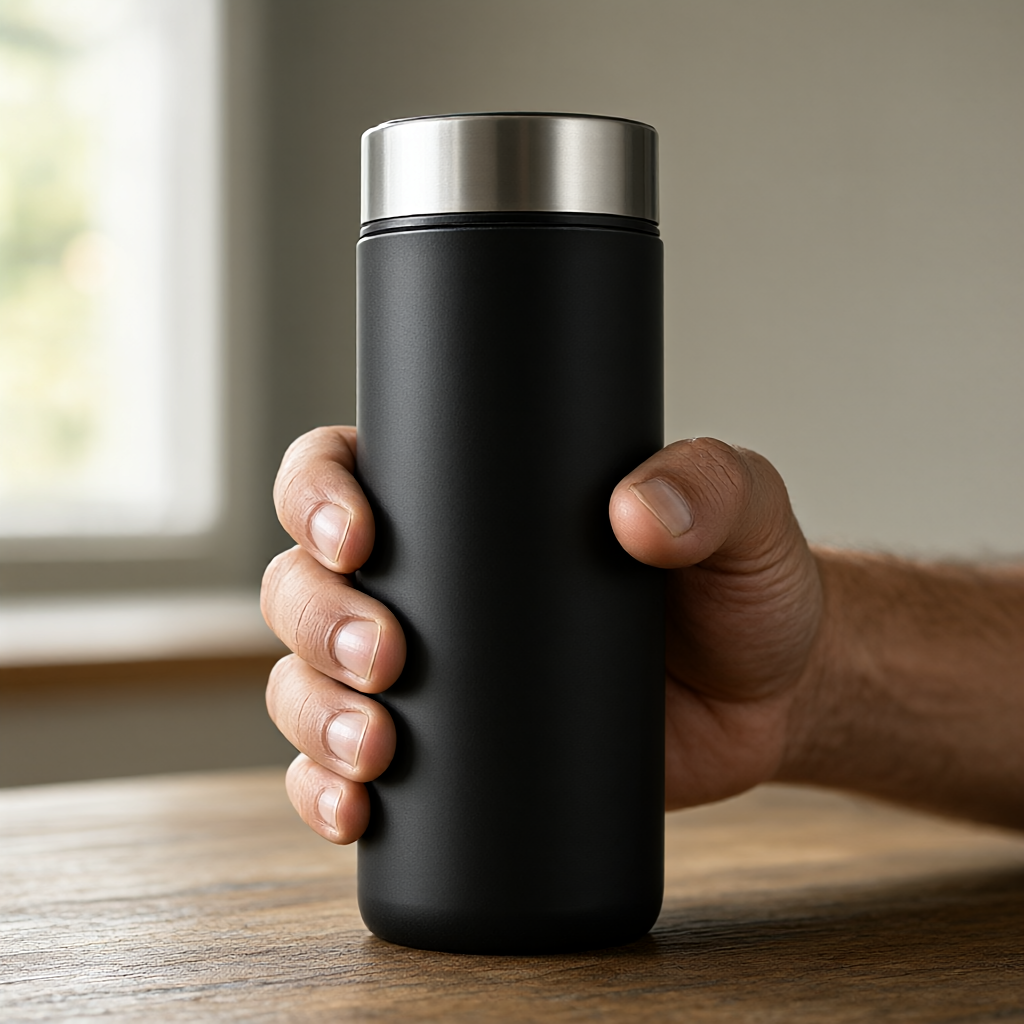
Selecting a water bottle for a larger hand requires evaluating grip circumference, filled weight, and cap operation. Standard bottles often feature narrow profiles that force a tight squeeze or slip from the grip, while high-capacity options become too heavy to hold comfortably during extended use. The correct bottle matches the user's hand spread, provides adequate fluid volume without causing wrist strain, and allows one-handed opening.
Hand Measurement and Grip Circumference
Measure the hand spread to determine the minimum bottle diameter for a comfortable grip. Use a measuring tape to find the distance from the tip of the thumb to the tip of the middle finger with the hand fully extended. Divide this measurement by pi (3.14) to calculate the maximum cylindrical diameter the fingers can encircle. A hand spread of 25 cm yields a maximum encircled diameter of roughly 8 cm. Bottles with diameters exceeding this calculated value require a pinch grip rather than a full wrap, which reduces holding security.
Bottle shape dictates grip effectiveness beyond raw diameter. Cylindrical bottles with a consistent 7 to 9 cm diameter suit larger hands well. Tapered necks force the hand to slide upward, concentrating the weight on a smaller surface area and increasing muscle fatigue. Square or rectangular bottles measure wider across the diagonal, making them harder to hold than the flat sides suggest. Test the grip by holding the bottle full of water; the fingers should overlap the thumb or touch the opposite side of the cylinder without straining.
Texture and material friction alter the required grip force. Smooth stainless steel or glass requires higher grip pressure to prevent rotation compared to powder-coated metal or silicone-wrapped exteriors. A silicone sleeve or molded grip panel reduces the active squeezing force needed to hold the bottle, which minimizes hand and forearm fatigue during prolonged carrying.
Capacity Versus Filled Weight
Capacity dictates filled weight, which directly affects wrist and forearm strain. One milliliter of water adds one gram of mass. A 1-liter bottle filled with water weighs 1 kilogram, plus the empty vessel weight. Stainless steel bottles often weigh 300 to 400 grams empty, pushing the total carried weight to 1.3 or 1.4 kilograms. For individuals with limited wrist endurance or joint pain, carrying over 1.5 kilograms in one hand for extended periods causes discomfort. Select a capacity that provides sufficient hydration between refills without exceeding a comfortable carrying threshold.
Calculate the practical carry duration based on typical intake rates. At a consumption rate of 250 milliliters per hour, a 1-liter bottle requires a refill every four hours. If the primary use case involves sitting at a desk, a heavier 1.5-liter bottle remains stationary and weight is less relevant. If the bottle accompanies walks or errands, a 750-milliliter bottle keeps the filled weight under 1 kilogram while still providing three hours of hydration.
Volume markings provide visual feedback for intake tracking. Embossed or printed markings on the exterior allow monitoring without opening the cap. Some wide bottles obscure markings when held in the dominant hand; ensure the measurement scale faces outward when gripped. Bottles lacking volume markers require external measurement or guesswork, reducing tracking accuracy.
Cap Mechanisms and One-Handed Operation
Cap design determines the ease of opening and closing the bottle while walking or performing other tasks. Screw caps require two hands or a firm grip on the bottle body to counter the twisting force. For larger hands, small screw caps under 4 cm in diameter lack sufficient surface area to generate torque without slipping. Flip-top or push-button caps allow one-handed operation by pressing a lever with the thumb while the fingers secure the bottle. Straw caps permit drinking without tilting the bottle, which helps manage the weight of high-capacity vessels.
Leak prevention relies on the sealing mechanism. Silicone gaskets inside the cap create a watertight seal against the bottle rim. Caps that screw down compress the gasket uniformly, providing reliable leak resistance. Flip-top mechanisms rely on a latch to press the gasket against the opening; if the latch tension is low, the seal fails under pressure or when inverted. Test flip-top seals by filling the bottle, closing the cap, and applying firm pressure to the body while shaking it over a sink.
Thread durability affects long-term usability. Plastic threads on screw caps strip or cross-thread if the cap is misaligned during closing, leading to leaks. Metal-on-metal threads on stainless steel caps resist stripping but require precise alignment to prevent galling. Caps with wide, coarse threads engage faster and tolerate minor misalignment better than fine-pitch threads.
Flow Rate and Chug Compatibility
Flow rate dictates how fluid transfers from the bottle to the mouth. Narrow openings restrict flow to a trickle, requiring prolonged tilting to drink. This extended tilt shifts the bottle's center of gravity forward, increasing the downward rotational force applied to the wrist. Wide-mouth openings measuring 5 cm or more allow high flow rates but can deliver fluid too rapidly, causing choking or spillage if the drinker cannot swallow fast enough.
Chug caps bridge the gap between restricted flow and uncontrolled glugging. These caps feature an opening measuring 2 to 3 cm, often with internal baffles that smooth the fluid delivery. The moderate opening allows a steady flow without the need to regulate the tilt angle precisely. When testing flow rate, fill the bottle to the halfway mark, invert it with the cap open, and observe the glugging pattern. A smooth, continuous pour indicates a balanced air-to-fluid exchange.
Internal baffles or flow regulators inside the cap prevent splashing. Some high-flow caps include a removable silicone insert that slows the stream. If the insert reduces the flow excessively for the user's preference, it can be removed. Evaluate the flow with and without the insert to find the delivery speed that matches the user's swallowing capacity.
Bottle Selection Checklist
Verify the following criteria before acquiring a water bottle for a larger hand. Measure the hand spread and calculate the maximum encircled diameter; ensure the bottle diameter is less than or equal to this value. Weigh the bottle filled to capacity; confirm the total weight does not exceed 1.5 kilograms for active carry or 2 kilograms for stationary use. Operate the cap mechanism using only one hand; ensure the thumb lever or screw cap provides adequate surface area for traction. Fill the bottle and invert it to test the flow rate; confirm the fluid delivery matches swallowing speed without causing glugging or spillage. Check the exterior texture; verify the presence of a silicone sleeve or powder coating that increases friction without adding excessive bulk.