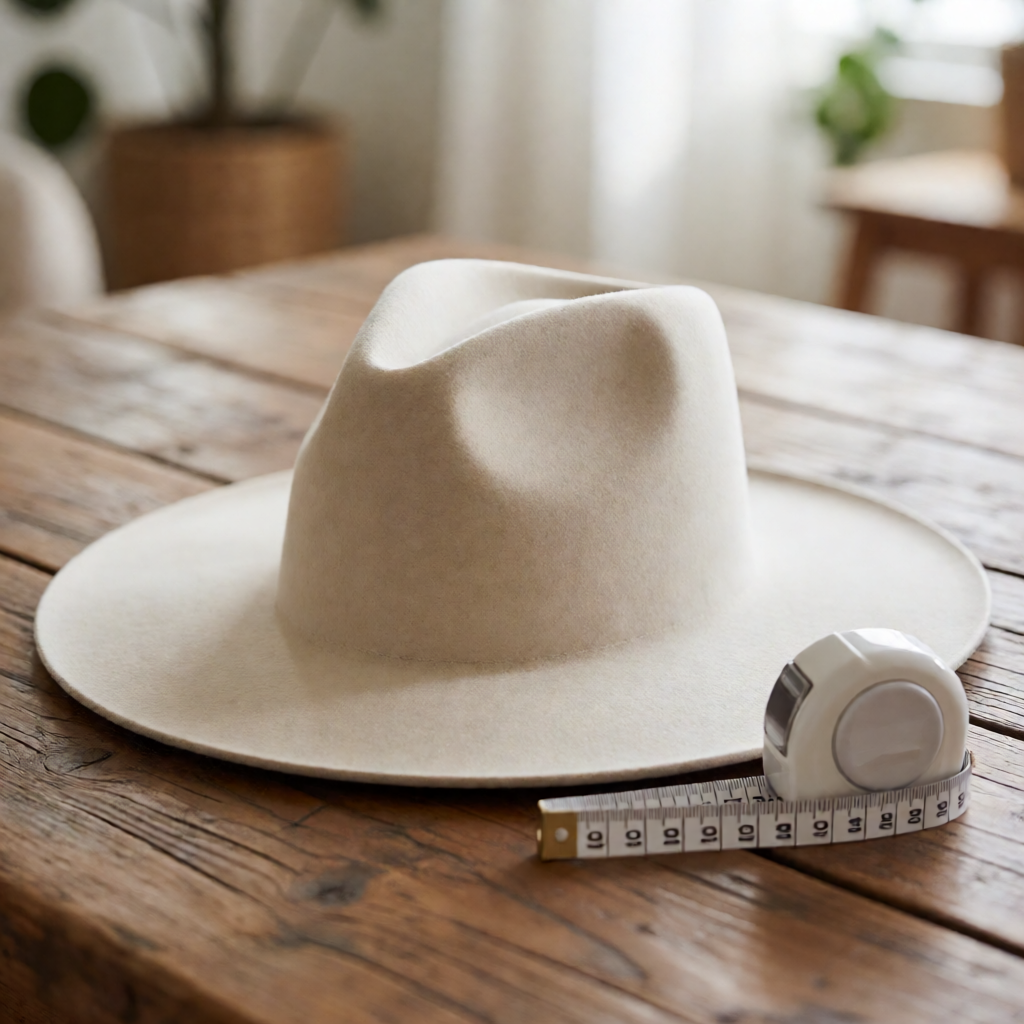
Finding a hat that fits a larger head requires moving beyond generic size labels like L or XL. Standard caps and hats max out at a 61 cm circumference, leaving wearers with red forehead indentations or hats that perch above the ears. A proper fit depends on three measurable factors: head circumference, crown depth, and brim width proportion. Getting these measurements right prevents slippage and eliminates the visual shrinking effect that undersized hats create on broader frames. The process involves precise measurement techniques and material-specific adjustments to ensure comfort and style integrity. This guide outlines the specific metrics required to achieve a secure and proportional fit for heads larger than the average retail standard.
Measuring Head Circumference and Accounting for Hair Volume
Wrap a flexible measuring tape around the head, positioning it over the mid-forehead and across the widest part of the occipital bone at the back. The tape must sit exactly where the hat band will rest. It is critical to keep the tape parallel to the floor to avoid skewing the data. Record the measurement in centimeters for precision. If the measurement falls between standard sizes, round up to the nearest half-centimeter, as hat shrinkage from washing or sweat is negligible compared to the discomfort of a tight band. Consistency in measurement is key; take the measurement three times and use the average if there are minor discrepancies.
Hair volume alters the effective circumference. Dense or curly hair adds 1 to 3 cm of bulk that a bare tape measurement misses. When measuring over styled hair, ensure the tape compresses the hair only as much as the hat band will. For wearers who alternate between wearing hair down and tied up, measure both ways. The hat must accommodate the larger measurement, using an adjustable strap or hat sizer filler to take up slack when hair volume decreases. This adjustment prevents the hat from sliding off when the hair is pulled back into a bun or ponytail, reducing the bulk under the crown.
Crown Depth Calculations to Prevent Ear Compression
Crown depth dictates whether a hat covers the ears or sits securely above them. On a larger head, a shallow crown forces the hat down onto the ears, creating pressure and distorting the hat shape. Measure crown depth by placing the hat on a flat surface and measuring from the internal center of the crown to the internal base of the band. For a comfortable fit above the ears, the internal crown depth must exceed the distance from the top of the head to the top of the ear by at least 2 centimeters. This buffer zone allows for thermal expansion of the fabric and prevents friction against the auditory canal.
Deep crowns accommodate high foreheads and voluminous hair, but excess depth causes the hat to slide down over the eyes if the band is loose. Balance depth with band tension. A structured crown with internal buckram stiffening holds its shape and resists collapsing down the forehead. An unstructured crown relies entirely on band fit to maintain its position. Larger heads benefit from structured crowns, as they distribute band pressure evenly across the forehead rather than concentrating it at the front. This even distribution reduces the likelihood of temporary pressure marks and improves overall comfort during extended wear.
Brim Width Scaling for Facial Proportion
Brim width determines visual proportion. A brim that is too narrow makes a larger head and broad face appear wider, while an oversized brim overwhelms the wearer. The scaling standard is a brim width that equals half the shoulder width, or roughly 1.5 times the face width measured cheekbone to cheekbone. For a 40 cm face width, a 6 cm brim on each side provides balanced framing. Fedoras, wide-brim sun hats, and bucket hats scale well using this ratio. This geometric relationship ensures that the hat frames the face without creating a top-heavy silhouette or leaving the neck exposed to sun.
Baseball caps and beanies lack variable brim width, making their proportionality harder to adjust. For caps, choose curved brims over flat brims; the curve breaks the horizontal line of a wide face. Flat brims extend the facial width visually. For beanies, cuffing adds bulk at the forehead, which can balance a wider jawline, but a slouchy uncuffed beanie elongates the head. Select the style based on whether the goal is to add horizontal balance or vertical length to the face shape. Understanding these stylistic effects allows for a more intentional selection of headwear that complements facial structure.
Hat Band Tension and Material Stretch Factors
Hat bands control retention. Rigid bands with zero stretch, such as leather or grosgrain, must match the head circumference exactly. A rigid band even 1 cm too small causes headache-level pressure within an hour. Elastic bands offer flexibility but degrade over time. When evaluating an elastic band, stretch it to its maximum and measure. If the stretched length is less than the head circumference, the band will roll off the back of the head during movement. Regular inspection of elastic elements is necessary to identify loss of tension before it becomes a functional failure.
Material composition dictates long-term fit changes. Wool felt shrinks with heat and moisture, tightening up to 2 cm over time. Straw hats lose shape in high humidity, causing the band to loosen. Cotton canvas hats shrink after washing unless pre-shrunk. To counter shrinkage, size up 1 cm for wool and cotton. To counter loosening, choose straw hats with a sweatband that has a rear drawstring or elastic insert for adjustable tension as the material relaxes. Anticipating these material behaviors ensures the hat remains usable over multiple seasons rather than becoming ill-fitting after a few wears.
Fit Evaluation Checklist
Verify head circumference matches the internal band length, allowing 1 cm of ease for rigid bands. Check that the internal crown depth clears the ears by at least 2 cm without pushing the hat over the eyes. Confirm the brim width measures at least 1.5 times the cheekbone width to maintain facial proportion. Test band tension by shaking the head forward and backward; the hat must shift less than 2 cm in either direction. Inspect the forehead after 10 minutes of wear; red lines deeper than 1 mm indicate a band that is too tight or too narrow. This final audit ensures all previous measurements align with the physical reality of the hat's construction and fit.