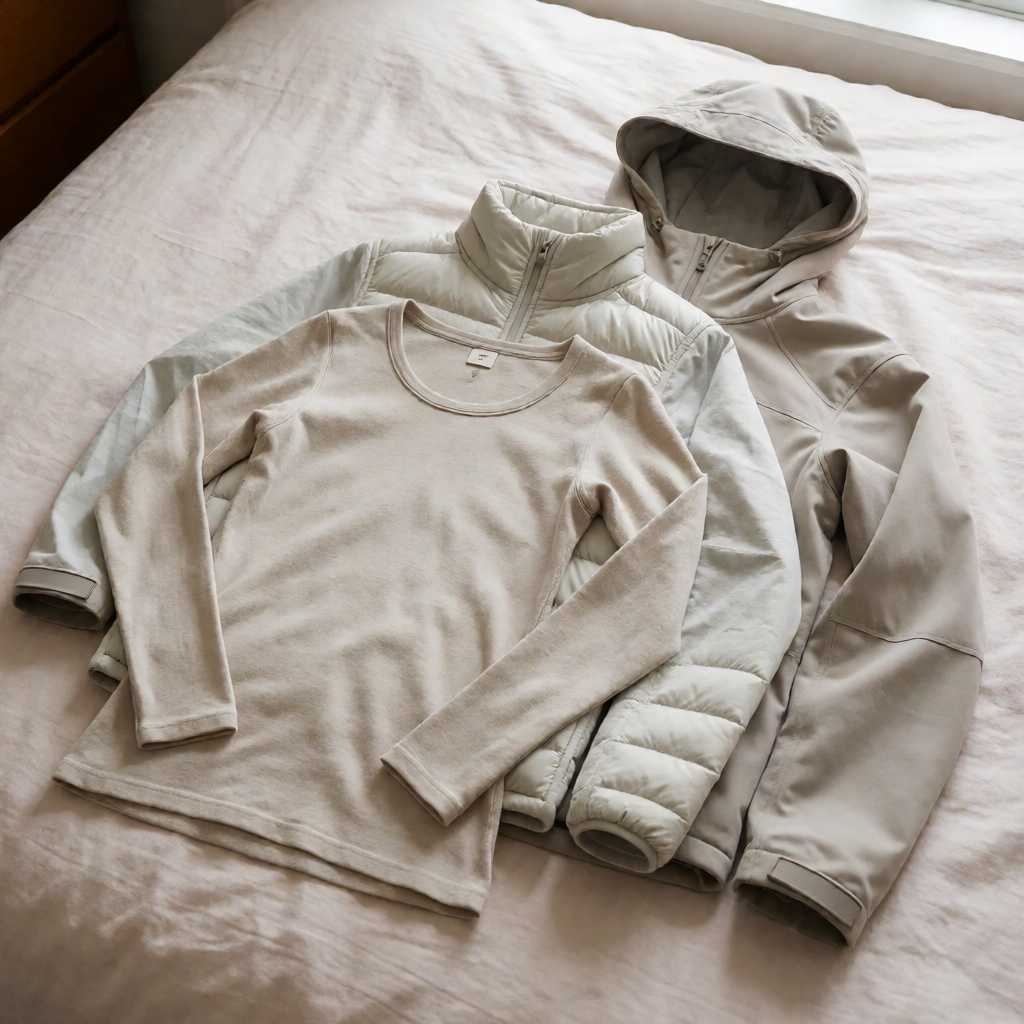
Effective winter layering for a larger body requires prioritizing fabric efficiency over garment thickness. Adding multiple thick layers restricts movement, compresses insulation, and raises body temperature too fast, leading to sweat retention and cold flashes. The functional approach uses three specific layers: a moisture-wicking base, a targeted mid-layer, and a vented shell, all sized to allow air trapping without constriction.
Base Layer Fabric and Fit
The base layer must move sweat away from the skin to prevent evaporative cooling. Merino wool blends and synthetic grids outperform cotton, which holds up to twenty times its weight in water. A 150 to 200 weight merino blend provides warmth without stretching out of shape. Synthetic grid fleece with open channels works for high-output activities where rapid drying is the priority.
Fit dictates wicking performance. A base layer that hangs off the skin cannot pull moisture effectively. The garment should skim the body without compressing the torso or limbs. For plus-size bodies, the primary failure point is seam placement. Standard side seams sit at the widest point of the torso or thigh, creating friction under other layers. Raglan sleeves are preferred for the upper body, while forward side seams are used for lower body base layers to shift seams away from high-friction zones.
Mid-Layer Insulation and Air Trapping
The mid-layer traps warm air in the micro-climate between the base and shell. Down and synthetic insulation function by lofting, which requires uninterrupted space. A mid-layer that is too tight compresses the loft, eliminating its insulating property. A mid-layer that is too loose allows heated air to escape through the collar and hem. The correct fit permits one inch of ease between the mid-layer and the base layer.
Bulky wool sweaters and thick sweatshirts are inefficient mid-layers because their dense fabric offers minimal dead air space relative to their thickness. A lightweight packable down jacket or a synthetic active-insulation vest provides a higher warmth-to-weight ratio. For plus-size bodies, a vest often works better than a full-zip jacket because it insulates the core without adding fabric volume under the arms, preserving mobility and preventing underarm binding.
Shell Layer Venting and Movement
The shell blocks wind and precipitation while allowing interior moisture vapor to escape. Hard shells made of non-breathable coated nylon trap sweat, soaking inner layers from the inside out. Woven soft shells with a durable water repellent coating offer sufficient weather resistance for dry cold and stretch to accommodate movement without riding up. For wet conditions, two-layer or three-layer laminated hard shells with taped seams are necessary.
Venting overrides breathability claims. Even high-end laminated shells cannot vent moisture fast enough during sustained movement. Pit zips are an essential shell feature. For plus-size bodies, standard pit zips often sit too high or too far forward. Zipper reach should be verified before purchase; the pull must be accessible without straining the shoulder. Chest vents and two-way front zippers offer additional dump options. A two-way front zipper allows opening the hem while keeping the chest sealed, releasing heat from the lower torso where larger bodies carry substantial mass and generate high heat.
Lower Body Layering Specifics
Lower body layering frequently fails due to fabric stacking at the groin and knees, which restricts stride length. Wearing thick fleece pants under jeans compresses the fleece and binds the hip flexors. The lower base layer should be a lightweight merino or synthetic tight. The outer layer must provide the insulation and wind block. Soft shell winter trousers with a fleece backing combine the mid and shell layers into one garment, eliminating the need for a bulky middle layer.
For extreme cold, a relaxed-fit insulated pant replaces the soft shell. The inner lining should be smooth nylon to slide over the base layer without catching. Cuff design matters for lower body layering. Wide leg openings fit over boots without bunching, but they also channel cold air up the leg. Insulated pants with internal draft flaps at the ankle or adjustable cuff snaps are suitable options that seal the gap between the trouser and the boot top.
Layering System Checklist
Base layer fabric is merino blend or synthetic grid, never cotton. Base layer seams are offset from the inner thigh and underarm. Mid-layer has at least one inch of ease over the base layer without excess volume at the hem. Mid-layer material is active insulation or packable down, not dense wool. Shell features pit zips accessible without shoulder strain. Shell has a two-way front zipper for torso heat dumping. Lower body uses a single smooth outer layer over a thin tight, avoiding stacked thick fabrics. Trouser cuffs seal against the top of the boot to prevent cold air channeling.