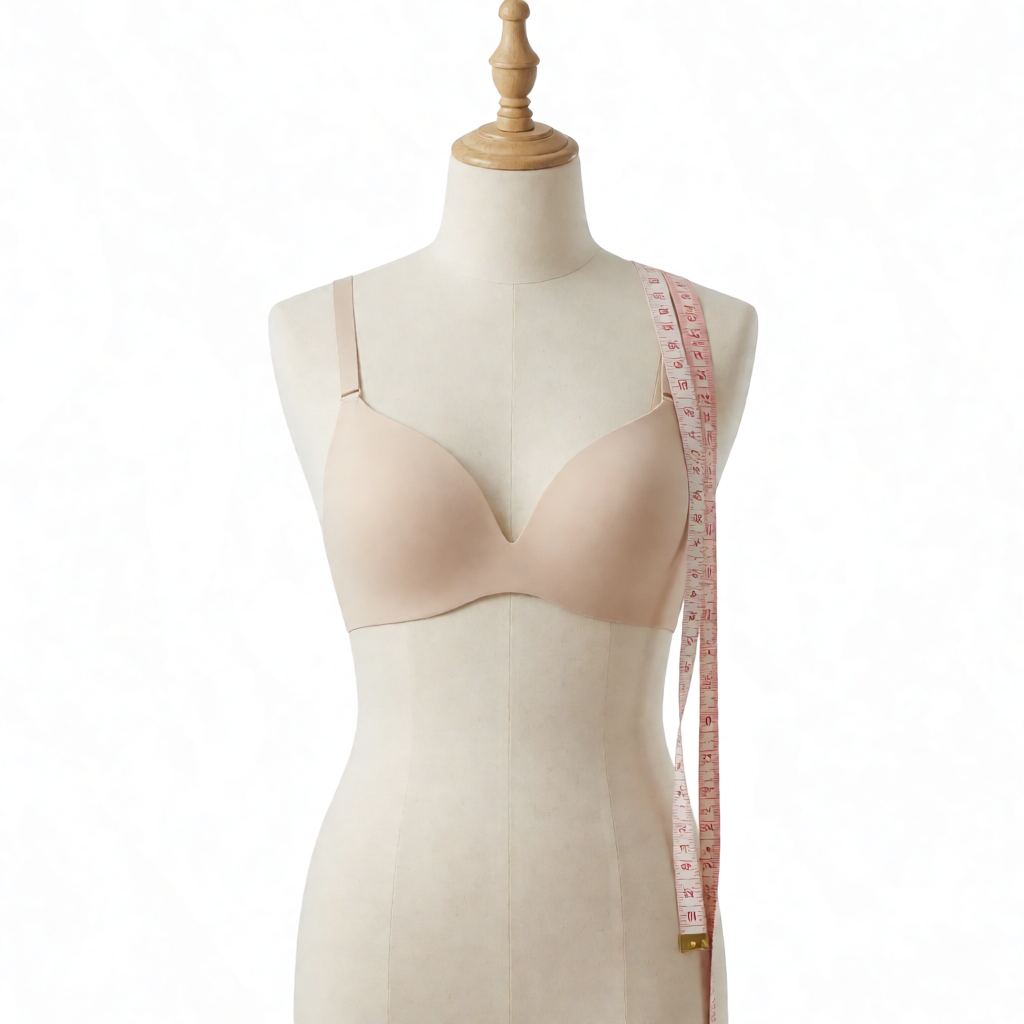
Bra fit is a mechanical problem more than a size label problem. For a plus size body, the band does most of the support work, and the cup must contain tissue without compressing it. A well-fitted bra holds the breast tissue forward and upward, with the band staying level across the back and the straps carrying minimal load. The correct fit reduces shoulder grooves, back pain, and skin irritation under the breasts.
Most fit issues trace back to two numbers: band size and cup volume. The band size is the ribcage measurement under the bust, typically 30 to 50 inches. The cup volume is the difference between the bust measurement and the band measurement. A one-inch difference is an A cup, two inches is a B cup, and so on. For a plus size body, the band often needs to be smaller than the underbust measurement suggests, because the band fabric must stretch around the ribcage and compress the back tissue.
Band Fit: The Foundation of Support
The band provides about 80 to 90 percent of the support in a bra. For plus size wearers, a loose band means the cups pull forward, the straps dig in, and the whole bra rides up. The band should sit horizontally across the back, not curve upward. A simple test is to hook the bra on the loosest set of hooks and slide two fingers under the back band. If your fingers move easily with no resistance, the band is too loose. If you cannot fit one finger under the band, it is too tight. The right fit allows two fingers with slight friction.
When you try a new bra, always start on the loosest hook. As the elastic stretches over time, you will move to the middle and then the tightest hook. If you start on the tightest hook, the bra will be too loose within a month. For a plus size body, the band should also have a wider back panel, usually three or four hook columns, to distribute pressure across the back muscles and avoid digging into the skin.
Cup Fit: Volume and Shape, Not Just Letter Size
Cup fit is about volume and shape, not just the letter on the tag. A D cup in one brand may hold more than a D cup in another. The wire or the underarm seam must sit on the ribcage, not on breast tissue. If the wire sits on tissue, the cup is too small. If the wire sits too far forward, the cup is too large. The center gore, the piece between the cups, should lie flat against the sternum. If it floats, the cups are too small or the band is too loose.
For a plus size body, breast tissue often extends toward the underarm. The side of the cup must fully contain this tissue. If you see spillage at the underarm or the side seam cuts into the tissue, you need a larger cup or a style with a higher side panel. The top edge of the cup should not cut into the upper breast. If it does, the cup is too small or the style has too low a neckline. A full coverage cup with a higher neckline helps contain upper breast tissue and reduces the risk of spillage when bending forward.
Strap Fit: Width and Length Matter
Straps should be wide, typically at least three-quarters of an inch, and they should not dig into the shoulders. For a plus size body, narrow straps create grooves and can cause headaches or shoulder numbness. The strap length should be adjusted so that the straps sit flat against the shoulders without slipping. If the straps slip, the band is likely too loose. If the straps dig, they are too tight or the band is too loose.
For larger cup sizes, straps should be placed more toward the center of the shoulder, not at the edge. A racerback or a bra with a back adjustment can help keep straps in place. If your shoulders slope, you may need a bra with a higher back band or a style with a front closure. The strap should not cut into the trapezius muscle. If you see red marks that last more than an hour after removing the bra, the straps are too narrow or too tight.
Daily Comfort Checks and Common Fit Problems
After wearing a bra for a few hours, check for specific signs of poor fit. The band should not ride up. The center gore should remain flat. The underwire should not poke the armpit. The straps should not leave deep indentations. The breast tissue should not spill over the top or the sides. The bra should not cause chafing under the breasts or along the underarm.
Common problems include a band that is too loose, a cup that is too small, and a style that does not match your breast shape. For a plus size body, breast tissue is often fuller at the bottom or the sides. A balconette style may not contain side tissue. A full coverage style with a higher side panel is often a better choice. If you have a projected breast shape, a molded cup may compress the tissue. A seamed cup with a stretch fabric can accommodate more projection and still provide support.
Fit Testing at Home Without a Measuring Tape
You can test fit without a measuring tape. Put on your bra and hook it on the loosest set of hooks. Bend forward at the waist and let your breasts fall into the cups. Then stand up and adjust the tissue. The center gore should lie flat. The band should be level. The straps should not dig. Move your arms across your chest and then above your head. The bra should not shift. The band should not ride up. The cups should not gap at the top.
If the band rides up, it is too loose. If the center gore floats, the cup is too small or the band is too loose. If the side seam cuts into the underarm, the cup is too small or the style has too low a side panel. If the straps fall off, the band is too loose. If you have to tighten the straps to the shortest length, the band is too loose. A correct fit should not require the straps to be fully tightened.
Quick Checklist for Bra Shopping or Wardrobe Review
The following criteria serve as a reference for evaluating bra fit during shopping or wardrobe reviews.
1. The bra is hooked on the loosest set of hooks. 2. The band sits level and allows two fingers under the back band. 3. The center gore lies flat against the sternum. 4. The cups contain all breast tissue without spillage at the top, sides, or underarm. 5. The straps are wide and sit flat without digging. 6. The wire rests on the ribcage, not on tissue. 7. The bra stays in place during a full range of arm motion. 8. There is no chafing after several hours of wear. Adjusting the size or style is necessary if any of these conditions are not met.