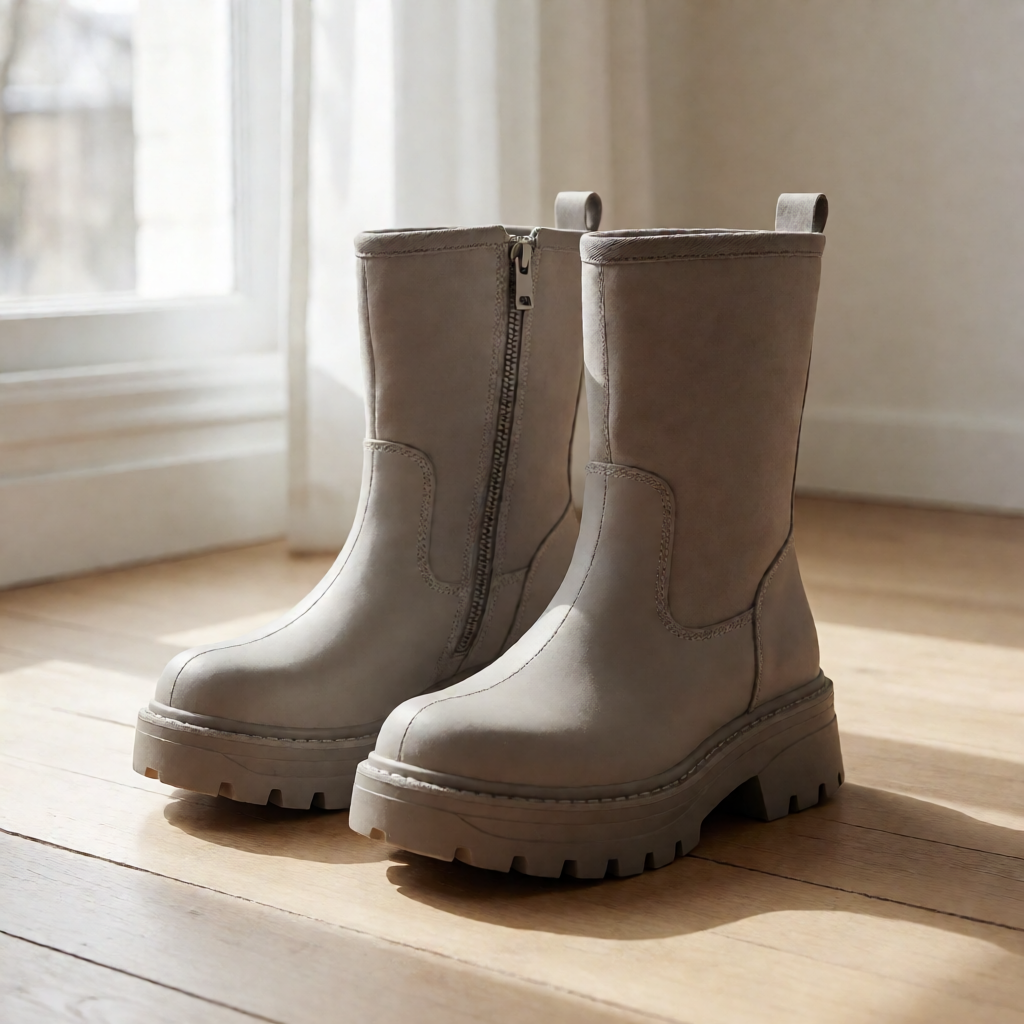
For a plus-size wearer, winter boots fail in predictable places. The boot does not close over the instep, the shaft presses into the calf, or the sole slides on wet pavement. Each problem traces back to a measurable dimension. This guide covers the three most important fit zones — shaft width, instep height, and sole contact — plus the entry process that ties them together.
Shaft Width and Calf Circumference
The shaft of a boot is the vertical section that covers the lower leg. Its width is fixed at the factory. Calf circumference changes with body position, footwear, and time of day. Measure the widest point of each calf in the morning and again in the evening. Use the evening measurement for boot sizing because legs typically expand slightly after standing.
Compare that number to the boot's shaft width, which is usually listed in the product description as a circumference at the top opening. A useful rule: the boot's top opening should be at least 0.5 inch larger than your calf circumference. If the difference is smaller, the shaft will press into the skin and leave marks after an hour of wear.
Boots with a side gusset or a laced shaft offer more adjustability. A laced shaft can be loosened at the top while staying snug at the ankle. A zipper shaft with a stretch panel works for calves that vary by more than an inch across the day. Fixed-width shafts with no stretch or lacing require a larger margin — aim for 1 inch of extra room at the top opening.
Do not rely on the calf size listed in a size chart alone. Some charts measure the boot at the lowest point of the shaft, others at the top. Check the measurement location. A boot that fits at the top may still bind at the mid-calf where the muscle is widest.
Instep Height and Entry Mechanics
The instep is the top of the foot where the laces or zipper sit. A high instep makes a low-cut boot opening difficult to enter. The boot opening must clear the instep while the foot is angled downward. If the opening is too small, the foot cannot slide forward into the toe box without forcing the heel down.
Test entry with the boot fully unlaced or unzipped. Sit on a chair, place the foot into the boot at a 45-degree angle, and push the heel toward the back. The foot should move in with a continuous, smooth motion. Any need to bounce the heel or pull the shaft sideways indicates an entry problem that will worsen with thick socks.
Boots with a tongue that is attached at the sides (a gusseted tongue) provide a wider opening when laces are loosened. A side zipper that runs from the top of the shaft to the ankle also helps, provided the zipper does not catch on the inner lining. Avoid boots with a narrow zipper opening that requires folding the shaft to close.
For a high instep, look for a boot with a removable insole. Taking out the insole adds roughly a quarter inch of vertical space inside the boot, which can ease entry without changing the shaft fit. A boot with a low-cut ankle and a separate gaiter offers an alternative: the gaiter wraps around the calf, while the boot itself opens widely at the foot.
Sole Traction and Surface Contact
Winter boots for heavier loads need a sole that distributes weight over a broad contact area. A narrow sole with deep lugs concentrates pressure and can feel unstable on ice. A wider sole with a flat profile between lugs provides more grip on packed snow and less rocking on uneven pavement.
Inspect the lug pattern. Lugs that run in a zigzag across the full width of the sole perform better on ice than a smooth central strip. A heel block with horizontal grooves adds braking power when walking downhill. A toe block with a slight upward curve reduces catching on curbs.
Rubber hardness matters. Softer rubber compounds grip better in cold temperatures but wear faster on dry pavement. A dual-density sole — hard rubber at the perimeter, softer rubber at the contact patches — balances durability and traction. If the product description does not specify rubber hardness, look for a sole with visible siping (thin slits) in the rubber, which increases surface friction on wet ice.
Do not assume that a deep tread equals good grip. Deep lugs on a soft sole can flex and lose contact with the ground. Press the sole with your thumb. It should feel firm, not spongy. A firm sole maintains a stable contact patch under a heavier body weight.
Toe Box, Heel Slip, and Sock Thickness
The toe box must be wide enough for the toes to spread without pressing against the sides. A narrow toe box forces the foot to slide forward, which creates heel slip. With a heavy winter sock, the toe box should have at least a thumb's width of space in front of the longest toe.
Heel slip is measured while walking. A small amount of vertical movement — less than a quarter inch — is normal. Any more indicates that the boot is too long or the heel cup is too shallow. A boot with a padded heel collar reduces slip by holding the heel in place.
Sock thickness changes the fit. Test the boot with the sock you plan to wear most often. A wool blend sock that is 2 to 3 millimeters thick is typical for winter walking. If you need a thicker sock for very cold days, the boot should have enough volume to accommodate it without compressing the foot.
For plus-size feet that tend to swell, try the boot in the afternoon. A boot that fits comfortably in the morning may become tight after a few hours of walking. Leave a small margin in the toe box and instep for this expansion.
Materials and Weather Protection
Leather and synthetic uppers behave differently in cold weather. Full-grain leather is durable and molds to the foot but requires regular conditioning. Synthetic uppers, such as nylon or polyurethane, are lighter and dry faster but may crack at the flex points after a season.
Waterproof membranes are common in winter boots. A membrane that is rated for at least 10,000 millimeters of water pressure provides adequate protection for walking in slush. The membrane should be paired with a sealed or taped seam construction. Unsealed seams allow moisture to enter at the stitching lines.
Insulation is measured in grams. For most winter walking, 200 grams of insulation is sufficient. Heavier insulation — 400 grams — is useful for standing still in cold weather but can make the boot feel bulky and reduce ground feel. A boot with a removable liner allows you to adjust insulation based on the day's temperature.
Fit Checklist for Purchase
Use this list when comparing boots. Each item is a pass or fail test. A boot that fails more than one item should be set aside.
1. Measure the calf at the widest point in the evening. The boot's top opening should be at least 0.5 inch larger. 2. Unlace or unzip fully. Slide the foot in at a 45-degree angle. The motion should be smooth without bouncing. 3. Walk on a hard floor for two minutes. Heel slip should not exceed a quarter inch. 4. Press the sole with a thumb. The rubber should feel firm and not compress easily. 5. Check the toe box while standing. There should be a small gap in front of the longest toe. 6. Flex the ankle. The boot should bend at the ball of the foot without cutting into the top of the foot. 7. Wear the boot for 15 minutes at home. Remove it and check for red marks on the calf or top of the foot.
Selecting a plus-size winter boot requires attention to three dimensions: the shaft opening, the instep height, and the sole contact. The correct boot will close without force, walk without heel slip, and grip without excessive weight on the sole. These checks take less than ten minutes per pair and prevent the most common fit failures.